
DRG stimulation is a targeted form of neurostimulation that’s designed to calm nerve pain in specific, hard-to-treat areas—especially when other treatments haven’t gotten you where you need to be.
Plain-English definition
What “dorsal root ganglion” means
The dorsal root ganglion (DRG) is a small cluster of sensory nerve cell bodies that sits along your spine. Think of it like a switchboard for sensation. Each DRG is associated with specific parts of the body, which is why it matters so much for focal pain—like one foot, one knee, or one groin area.
What “neurostimulation” actually does
Neurostimulation uses mild electrical pulses to change how nerves send signals. It doesn’t “erase” your nerves or fix a structural problem. It’s more like turning down the volume on the pain signal so your brain isn’t constantly getting blasted by it.
What DRG stimulation is designed to treat
Focal/isolated neuropathic pain vs broad pain patterns
DRG is built for focal neuropathic pain—pain that stays in a smaller, defined area and behaves like nerve pain (burning, stabbing, hypersensitive, electric, pins-and-needles). It’s not the first-line tool for broad, all-over pain patterns. If your pain is diffuse and doesn’t map cleanly to a specific territory, DRG may not be the best match.
DRG vs spinal cord stimulation (SCS)
Why DRG is often positioned as more “targeted”
Both DRG and spinal cord stimulation (SCS) use electrical pulses to reduce pain signaling. The difference is where the therapy aims. Traditional SCS often affects broader pathways and can cover larger regions. DRG stimulation is typically framed as more precise because it targets the specific DRG linked to the painful area—making it especially useful for smaller zones like the foot, knee, groin, or rib.
How DRG Stimulation Works
The DRG as a pain-signal gate
“Traffic light” explanation of sensory signaling
A lot of competitors describe the DRG like a traffic light for pain signals. That’s a good analogy. Sensory messages travel up toward the brain, and the DRG helps regulate that flow. DRG stimulation aims to “re-tune” that gateway so pain signals don’t pass through as loudly or as often.
Why DRG therapy can be more focal
Mapping DRGs to specific pain territories
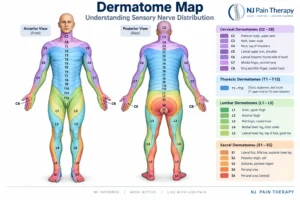
Because different DRGs correspond to different body regions, DRG stimulation can be selected based on where you hurt. In plain terms: if your pain is in a tight zone, the provider can target the DRG level that matches that zone instead of trying to “blanket” a wider area.
Paresthesia vs paresthesia-free therapy
Tingling optional vs none depending on programming
Some people feel paresthesia (a tingling sensation) with stimulation. Others get relief with little to no tingling at all. This depends on how the device is programmed and what your body responds to. The goal is comfort + function—not forcing a sensation.
Why positioning changes may matter less (vs traditional SCS)
Simple explanation of “positional effects”
With some traditional SCS systems, changing posture can change how stimulation feels—sit, stand, bend, and the sensation may shift. DRG stimulation is often described as having less positional variation for many patients because the anatomy around the DRG is more consistent. Practically: people often report steadier coverage of that small painful area.
What Conditions DRG Stimulation Is Used For
Complex regional pain syndrome (CRPS)
Hallmarks: severe pain, hypersensitivity, extremity focus
CRPS is one of the most commonly mentioned use cases. It’s known for pain that feels out of proportion, with hypersensitivity, burning, color/temperature changes, swelling, and a strong “don’t touch it” response—often in an arm, hand, leg, or foot. DRG is frequently positioned for CRPS because the pain is often localized and intense.
Localized neuropathic pain
Post-injury / post-surgical focal pain
Some people develop persistent nerve pain after surgery or injury—like a knee procedure that healed, but the pain didn’t get the memo. DRG stimulation can be considered when pain is clearly nerve-like and stays in a defined region that maps to a specific DRG level.
Pelvic pain, groin neuralgia
Groin and pelvic pain can be extremely disruptive—and notoriously hard to treat because the area is complex and pain can be very focal. DRG stimulation is often discussed as an option when the pain is neuropathic and stubborn.
Phantom limb / post-amputation pain
Phantom limb pain can feel shockingly real. DRG stimulation is sometimes used when the pain pattern is focal and neuropathic, and other approaches have fallen short.
Other focal pain areas
Foot, knee, hip, groin, rib (and other hard-to-treat spots)
DRG therapy is commonly framed for smaller, specific pain territories—especially lower-body sites (foot, knee, hip, groin) and other stubborn zones like the ribs. The theme is consistent: smaller area, clearer target, nerve-like pain.
Who is a Good Candidate?
Duration and severity checkpoints
Chronic pain ≥ 6 months (typical threshold competitors cite)
Many clinics use six months of chronic pain as a rough checkpoint—especially when the pain has remained significant despite multiple attempts to treat it.
“Tried conservative care” definition
PT, meds, injections, nerve blocks, etc.
Before DRG, most people have already tried some combination of:
- Physical therapy
- Medication management
- Injections or nerve blocks
- Lifestyle changes and rehab plans
- Possibly other procedures
DRG becomes a conversation when those steps don’t provide enough relief—or relief isn’t lasting.
When DRG is considered after other neurostimulation
Partial response to SCS / hard-to-cover pain zones
DRG is often considered when a person tried SCS and got partial coverage—or when the pain sits in a tricky area that’s hard to cover well with broader stimulation.
When DRG may not be appropriate
Broad diffuse pain without a clear focal target
If pain is widespread, constantly shifting, or doesn’t map to a specific territory, DRG may not be the right tool. DRG works best when there’s a clear “this is where it hurts” zone.
Patient-specific surgical/medical contraindications (keep general)
There are also individual medical factors that can make any implant-based therapy a poor fit—like infection risk, bleeding risk, or other conditions that change procedure safety. That’s why candidacy should be a structured medical evaluation, not a quick yes/no.
The DRG System Components
Leads / electrodes
Where they sit and what they do
Leads are thin insulated wires with electrode contacts that sit near the targeted DRG. They deliver the stimulation that modulates pain signals.
Implantable pulse generator (IPG)
Battery-powered device under the skin
The IPG is the small battery-powered unit implanted under the skin. It creates the stimulation pulses and powers the system.
Extensions (when used)
Sometimes an extension is used to connect leads to the generator depending on placement and anatomy.
Patient controller
Adjust stimulation, switch programs, turn on/off
Patients typically get a handheld controller that lets them:
- Switch programs
- Adjust intensity within safe limits
- Turn stimulation on/off
It’s meant to help you fine-tune comfort and coverage, not “self-treat” without clinical guidance.
The DRG Trial Phase
Why a trial comes first
Proving benefit before committing
Before any permanent implant, most clinics do a trial. The point is simple: prove you actually get meaningful relief before you commit to a long-term device.
What happens during the trial procedure
Temporary leads + external stimulator
Temporary leads are placed near the target DRG and connected to an external stimulator. You go home and live your normal life (within guidelines) while you test the results in the real world.
Trial length and what you track
Pain scores, function, sleep, activity tolerance
During the trial, you track:
- Pain level (and how often it spikes)
- How far you can walk or stand
- Sleep quality
- Ability to work, drive, do chores, and exercise
The best data is functional—what you can do again.
What counts as a “successful” trial
Often framed as meaningful relief (commonly ≥50% in some clinics)
Many practices use a threshold like 50% pain improvement as a marker of success, but real success is broader: better function, better sleep, better day-to-day life with less pain interference.
Trial removal and next-step decision
At the end of the trial, the temporary leads are removed. Then you and your provider review the results and decide whether a permanent DRG implant makes sense—or whether another path is better for your diagnosis.
The Permanent Implant Procedure
Drg stimulation moves from “trial” to “permanent” only if you proved it helps you in real life—walking, sleeping, working, and moving with less pain.
Day-of procedure overview
This is typically a minor surgical procedure done with imaging guidance. The goal is to place the stimulation leads near the specific dorsal root ganglion (DRG) that matches your pain territory. You’re not guessing—you’re targeting. Once the leads are in the right position, they’re connected to the implanted generator.
Where the generator is implanted
The generator (battery/pulse device) is implanted under the skin in a “pocket.” Common locations are typically the upper buttock/low back area or sometimes the abdomen depending on anatomy, comfort, and the routing needed to connect leads.
Programming and follow-ups
The implant is only step one. The real performance comes from programming—fine-tuning stimulation settings based on your pain map and goals. Expect follow-ups early on to dial in:
- Which programs work best for different activities
- What intensity feels effective without being annoying
- Whether you prefer tingling sensation or not (when possible)
Reversibility
DRG therapy is adjustable and reversible in the sense that:
- You can turn it off
- Settings can be changed
- Removal is possible if it’s not helping or if there are complications
It’s not “one-way.” That matters.
Results and What Patients Can Expect
What “targeted relief” looks like
DRG is usually framed around small, stubborn pain zones—think foot, knee, groin/pelvis, ribs, or other focal regions that are hard to cover with broader stimulation. The best-case scenario is that your pain coverage feels “locked on” to the area that actually bothers you.
Function outcomes
Pain scores matter, but function is the real win. People pursue DRG because they want to:
- Walk farther and stand longer
- Tolerate physical therapy without flaring
- Sleep better
- Reduce how much pain hijacks their day
Mood and quality-of-life angle
Chronic pain doesn’t just sit in your body—it eats your attention, your patience, and your motivation. When pain quiets down, people often notice improvements in:
- Sleep and energy
- Stress response
- Confidence moving again
That’s not “in your head.” That’s what happens when you’re not bracing all day.
Realistic expectations
This is not a cure for arthritis, nerve damage, or structural problems. It’s a signal-modulation tool. The goal is meaningful relief and better function—not perfection.
Risks, Side Effects, and Recovery
Trial-related issues
During the trial, the most common annoyances are:
- Skin irritation from adhesive
- Local soreness
- Infection risk considerations any time something passes through skin
Trials are usually short, but they still require clean site care and attention.
Implant-related risks
Keep expectations grounded: it’s still a procedure. Risks can include:
- Typical surgical risks (bleeding, infection, pain at the implant site)
- Lead migration (coverage changes if a lead shifts)
- Need for reprogramming visits (common, not a failure)
- Device-related issues that may require adjustments or revision
Your clinician should walk you through what’s rare vs what’s common.
Recovery timeline
Most patients are back to light activity within days, but there are early restrictions to protect the leads and incision sites. The big theme early on is: avoid excessive bending/twisting/heavy lifting until your provider clears you.
When to call your provider
Don’t wait it out if you have red flags, especially:
- Fever or chills
- Increasing redness, warmth, swelling, or drainage at incision sites
- Severe new weakness, numbness, or loss of bladder/bowel control
- Rapidly worsening pain that feels different than your baseline
If something feels “off,” call.
DRG Stimulation vs Other Pain Treatments
DRG vs SCS
Both use electrical stimulation. SCS is often used for broader pain patterns. DRG is often favored when pain is focal and hard to cover—like foot, knee, groin, pelvic, or rib-type regions.
DRG vs RFA
RFA uses heat to disrupt pain signaling (often for facet-type pain patterns). DRG uses stimulation to modulate sensory signaling at a targeted nerve gateway. Different tools for different diagnoses.
DRG vs peripheral nerve stimulation (PNS)
PNS targets peripheral nerves closer to the painful area (often with temporary or external systems depending on type). DRG targets the sensory gateway near the spine for a defined territory. If your pain is very localized, either could be considered depending on anatomy and the clinician’s strategy.
DRG vs medications
Medications can help, but they’re systemic and can come with side effects. DRG is localized and device-based. Some people pursue it to reduce reliance on meds—but it’s not promised, and any medication changes should be provider-led.
FAQs About DRG Stimulation
Is DRG stimulation permanent?
The device is implanted long-term, but the therapy is adjustable. It’s not “permanent” in the sense that it’s removable if needed.
Do I need a trial first?
In most care pathways, yes. The trial is how you prove the concept before committing to an implant.
How targeted is it compared to SCS?
DRG is typically described as more targeted for smaller pain territories, while SCS often covers broader regions.
Can it be turned off or removed?
Yes. You can turn it off, and removal is possible if clinically necessary.
How long does the battery last?
Battery life varies based on usage and device type. Your provider will give the realistic range for the specific system they use.
What does it feel like?
Some people feel tingling (paresthesia). Others get relief with minimal sensation. Programming is designed to land on “effective + tolerable.”
Key Takeaways
- DRG stimulation is built for focal neuropathic pain, especially stubborn, hard-to-treat areas.
- The permanent implant happens only after a successful trial.
- Expect programming visits—fine-tuning is part of the process, not a problem.
- Best outcomes are usually measured in function (walking, sleep, PT tolerance), not just pain scores.
- Risks exist (skin issues, infection, lead migration), but many issues are manageable with follow-up.
- DRG is often positioned as more targeted than traditional SCS for smaller pain territories.
If your pain is localized (foot, knee, groin/pelvis, rib) and has lasted months despite PT, meds, and injections, book a pain evaluation to see if a DRG trial makes sense. Contact the center for regenerative therapy and pain management today for expert pain treatments in NJ.