
Common pain after a car accident isn’t just “soreness”—it’s often a mix of muscle strain, joint irritation, and sometimes nerve involvement that can show up in the neck, back, shoulders, and even headaches.
- What’s common: neck pain/whiplash, upper and low back pain, headaches, shoulder pain, hip/knee pain, and tingling down an arm or leg.
- What’s normal vs urgent: mild-to-moderate soreness and stiffness can be normal; neurologic symptoms, chest pain, severe headache, or one-leg swelling are not.
- Why pain can show up later: adrenaline wears off, inflammation builds, and your body starts compensating without you realizing it.
- How pain management helps: when pain doesn’t resolve, we identify the main pain driver and build a plan—rehab + non-opioid strategies + targeted procedures when appropriate.
If your common pain after car accident symptoms aren’t improving, our team offers pain treatment in New Jersey focused on finding the real pain driver and building a plan that gets you moving again.
Why Pain After a Car Accident Can Be Delayed
Adrenaline + inflammation lag
Right after a crash, adrenaline can mask symptoms. Then inflammation ramps up over the next 24–72 hours. That’s why people often say, “I felt okay yesterday, and today I’m wrecked.”
Muscle guarding and “compensation” patterns
After impact, your body protects itself. Muscles tighten to stabilize the spine and joints. That guarding can create secondary pain—tight neck/upper traps, mid-back tension, low back spasm—especially if you’re moving differently to avoid discomfort.
Minor injuries that worsen with normal activity
Small sprains/strains can feel mild at rest but flare once you go back to normal life: sitting at work, driving, lifting groceries, walking stairs. It’s not you being “weak”—it’s the injury showing itself under load.
Red Flags After a Car Accident
Symptoms that warrant urgent evaluation
Some symptoms need immediate medical attention, especially if they’re new or worsening:
- Severe or worsening headache, confusion, fainting, vomiting, vision changes
- Weakness, numbness, or tingling that’s progressing, trouble walking, loss of coordination
- Loss of bladder or bowel control
- Chest pain, shortness of breath, or persistent rib pain with breathing issues
- Severe abdominal pain or abdominal tenderness that’s getting worse
- Fever or feeling acutely ill
- Significant swelling/pain in one leg (especially calf swelling/tenderness)
If you’re debating whether it’s serious, treat it like it is until a clinician clears it.
The Most Common Pains After a Car Accident
Neck pain (whiplash)
This is the classic one. Common signs:
- Stiffness and limited range of motion
- Muscle spasm and tight upper traps
- Pain turning your head or looking up/down
- Sometimes headaches that start at the base of the skull
Whiplash pain can be muscular, joint-based (facet irritation), or occasionally nerve-related.
Upper back pain (thoracic strain)
Usually felt between the shoulder blades.
- Tightness, aching, “gripping” muscle pain
- Pain with posture changes or twisting
- Sometimes worse with deep breaths or long periods of sitting
This often comes from sudden bracing during impact.
Low back pain
This can be a straightforward strain—or a disc/nerve pattern.
- Strain/sprain: sore, tight, worse with bending/lifting, improves with movement over time
- Disc irritation/nerve pattern: pain that shoots into the buttock/leg, numbness/tingling, worse with sitting or coughing/sneezing
The pattern matters because treatment choices differ.
Shoulder pain
Shoulders take stress from bracing on the wheel or seatbelt forces.
- Rotator cuff irritation (pain lifting arm, reaching overhead)
- AC joint irritation (top of shoulder pain)
- Seatbelt-related strain across chest/shoulder
- Stiffness and guarded movement that turns into persistent pain
Headaches
Not all post-accident headaches are the same:
- Cervicogenic headaches: start in the neck/base of skull, worse with neck motion
- Tension headaches: pressure/tight band feeling, often stress + muscle guarding
- Concussion-related: headache with dizziness, light sensitivity, nausea, brain fog
If headaches are severe, worsening, or paired with neurologic symptoms, get evaluated urgently.
Arm or leg pain / tingling
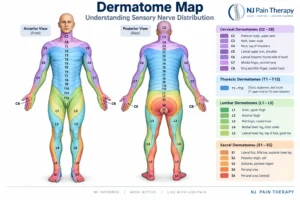
Tingling or radiating pain usually points to nerve irritation.
- Neck issues can refer into the shoulder/arm/hand
- Low back issues can refer into the hip/leg/foot
This doesn’t automatically mean something is “permanent,” but it does mean you should get assessed sooner rather than later.
Hip pain
Hip pain after a crash can be:
- Joint irritation (deep groin pain)
- Soft tissue strain (outer hip/glute pain)
- Referred pain from low back
- Worsened by walking, stairs, or getting in/out of a car
Hip and low back often overlap—sorting them out is key.
Knee pain
Knee pain can come from:
- Dashboard impact (front-of-knee pain, bruising, swelling)
- Twisting injury during the crash (meniscus-style symptoms, instability)
- Post-traumatic inflammation that makes stairs and squatting painful
Swelling, locking, or instability needs proper evaluation.
Chest wall pain / seatbelt soreness
Seatbelt soreness is common, but persistent or intense symptoms need attention.
- Rib/chest wall strain can hurt with deep breaths, coughing, or turning
- Bruising across the chest/abdomen is common
- If there’s chest pain, shortness of breath, worsening pain, or abdominal tenderness, don’t brush it off—get checked out.
What’s Causing the Pain? (Simple “Pain Generator” Breakdown)
Muscle strain + ligament sprain
The most common. Achy, tight, sore muscles and “pulled” feeling—usually worse with movement, better with rest, and improves over days to weeks.
Facet joint irritation (neck/back)
Small joints in the spine can get irritated from sudden force. This often feels like sharp, localized pain with turning, bending, or looking up/down.
Disc irritation or herniation (radicular patterns)
When pain shoots down an arm or leg, or you get numbness/tingling, a disc can be part of the story. Sitting, coughing, or bending can make it worse.
Nerve inflammation/compression
Nerves can be irritated without a big “disc herniation” headline. Symptoms are often burning, tingling, electric pain, or hypersensitivity.
Joint inflammation (shoulder/hip/knee)
Impact and bracing can inflame joints and surrounding tissue—shoulder (rotator cuff/AC), hip (deep ache), knee (swelling, pain on stairs).
Post-traumatic headaches and concussion overlap (high-level)
Some headaches are neck-driven (base of skull + stiffness). Others come with concussion symptoms like dizziness, light sensitivity, brain fog—those need proper evaluation.
How We Evaluate Accident-Related Pain in Clinic
Pain map + timeline + mechanism of injury
We get specific: where it hurts, what it feels like, what triggers it—and how the crash happened (rear-end vs side impact, head position, seatbelt injury, immediate vs delayed symptoms).
Physical exam + neurologic screening
We check range of motion, strength, sensation, reflexes, gait, and do targeted tests to see if this is more muscle/joint vs nerve-driven pain.
Imaging review (when appropriate)
We review X-rays/MRIs/CTs when they’re actually useful—either to rule out serious issues or to confirm a likely pain source. Not every case needs imaging.
Identifying the primary pain driver
The goal is to name the driver: soft tissue vs joint vs nerve vs headache type. That’s what makes treatment effective instead of random.
First-Line Treatments We Typically Start With
Activity modification and pacing (without total rest)
“Do nothing” often makes stiffness worse. We aim for smart movement—enough to prevent locking up, not so much you flare for two days.
Physical therapy / guided rehab
Mobility + stabilization + posture work + graded return to activity. PT is where a lot of recovery happens—when it’s matched to your pain pattern.
Non-opioid medication strategies (provider-guided)
Anti-inflammatories, topicals, and sometimes short-term supportive meds (like for spasm), depending on your symptoms and medical history.
Home strategies that support recovery
Ice/heat basics, sleep positioning, gentle daily movement, and avoiding “big flare” cycles.
Interventional Treatments for Persistent or Severe Pain
Trigger point injections (myofascial pain)
Helpful when muscle knots/spasm are driving pain and limiting motion.
Joint injections when indicated (shoulder/hip/knee)
Used when the exam points to a specific inflamed joint or surrounding structure—not as a default.
Epidural steroid injections (radicular arm/leg pain)
Considered when radiating nerve pain is a major feature and conservative care isn’t enough.
Facet-mediated pain options
If spinal facet pain is the driver: medial branch blocks → RFA when appropriate for longer relief.
Nerve blocks for headache/neck-driven pain (case-dependent)
For select headache patterns, nerve blocks (like occipital blocks) can reduce pain signaling and improve function.
Typical Recovery Timelines (and When to Escalate Care)
Soreness that improves vs pain that plateaus
Improvement week-to-week is the goal. If you’re stuck at the same pain level, you likely need a new strategy.
The “2–6 week” checkpoint (general guidance)
A lot of people improve in this window with the right plan. If you’re not improving—or symptoms are worsening—get evaluated.
When persistent pain suggests a missed pain generator
Ongoing pain often means we’re treating the wrong thing (or only part of the thing). That’s when targeted diagnostics and a tighter plan matter.
Frequently Asked Questions on Pain After a Car Accident
Why do I hurt more 2–3 days after a car accident?
Adrenaline fades and inflammation peaks. Delayed pain is common, but worsening neurologic symptoms are not.
Is whiplash serious?
It can be. Many cases improve, but persistent stiffness, headaches, or nerve symptoms should be assessed.
When should I get imaging?
If red flags are present, symptoms are severe, or you have progressive neurologic signs. Otherwise, it’s case-by-case.
What if PT makes it worse?
Some soreness is normal. Repeated flare-ups that last 24–72 hours usually mean the plan needs adjustment.
Can an accident cause nerve pain down the arm or leg?
Yes—neck or back irritation can trigger radicular symptoms like tingling, numbness, or shooting pain.
What treatments help when pain won’t go away?
Usually a combination: focused rehab + non-opioid strategies, and when needed, targeted injections, blocks, or RFA based on the pain driver.
Conclusion
Car-accident pain is common, but living with it long-term isn’t the goal. If your neck, back, headaches, or nerve symptoms are lingering, book an evaluation for pain treatment in New Jersey so we can pinpoint what’s driving your pain and map out the right mix of rehab, non-opioid care, and targeted procedures when needed.