
Pain management doctors don’t just “treat symptoms.” That’s one of the biggest misconceptions people have—and it’s why many patients feel stuck after seeing multiple providers without answers. In reality, diagnosis is often the main reason patients are referred to pain management.
Many pain conditions are missed or misunderstood because they don’t show up clearly on imaging or don’t fit a simple label. Pain management focuses on patterns—how pain behaves, what triggers it, and what relieves it—rather than chasing a single scan or symptom.
This guide explains what pain management doctors diagnose, how they do it, and when they’re the right specialist to see.
If you’ve been dealing with pain without clear answers, a pain management specialist can help identify what’s actually driving it.
What Does “Diagnose” Mean in Pain Management?
In pain management, diagnosis means identifying the pain generator—the tissue, nerve, or mechanism actually causing symptoms. It’s not just about naming a condition.
There’s an important difference between:
- Structural diagnosis: What imaging shows (disc bulge, arthritis, narrowing)
- Functional diagnosis: What’s actually causing pain in real life
Many people have abnormal MRIs without pain, and others have severe pain with “normal” imaging. Pain management focuses on why it hurts, not just where imaging looks abnormal.
What Conditions Pain Management Doctors Commonly Diagnose
Pain management specialists regularly diagnose:
- Back and neck pain
- Sciatica and radiating nerve pain
- Disc herniations and degenerative disc disease
- Spinal stenosis
- Joint pain and arthritis
- Nerve pain and neuropathy
- Failed back surgery syndrome
- Chronic headaches and migraines
- Complex or shifting pain patterns
These conditions often overlap, which is why a pattern-based approach matters.
How Pain Management Doctors Diagnose Pain
Detailed Symptom History
Diagnosis starts with listening. Pain specialists look closely at:
- When pain starts, worsens, or improves
- Triggers like sitting, standing, walking, or sleep
- Whether pain is constant, intermittent, or activity-related
- How symptoms change throughout the day
Pain behavior often reveals more than imaging ever will.
Physical and Neurological Examination
A focused exam helps identify what’s involved:
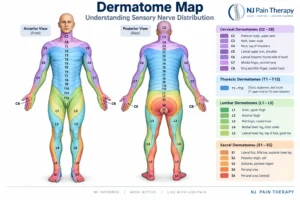
- Strength, sensation, and reflex testing
- Signs of nerve irritation or compression
- Distinguishing muscle pain from joint or nerve pain
This step helps narrow the pain source before any procedures are considered.
Movement and Posture Assessment
Pain management looks at how your body functions:
- How pain changes with sitting, standing, walking, or bending
- Whether movement improves or worsens symptoms
- Compensation patterns that overload other areas
Pain often comes from how the body is moving, not just what it looks like on a scan.
- Imaging Review (When Appropriate)
Pain management doctors review:
- MRI, X-ray, or CT findings when they’re relevant
- Whether imaging actually matches your symptoms
Imaging alone does not equal a diagnosis. Findings only matter if they explain what you feel.
Diagnostic Injections
In some cases, diagnosis is confirmed through response:
- Nerve blocks or joint injections help isolate the pain source
- Relief (or lack of it) provides valuable diagnostic information
These tools clarify pain drivers when symptoms are complex or overlapping.
What Pain Management Doctors Diagnose That Others Often Miss
Pain management specialists are trained to identify pain sources that don’t always show up clearly on scans or routine exams. These are some of the most commonly missed drivers of pain:
- Pain driven by inflammation rather than structural damage
Many people have pain caused by irritated tissue, not something “broken.” This type of pain often responds to targeted treatment even when imaging looks mild or normal. - Nerve irritation without obvious compression
Nerves can be chemically irritated or hypersensitive without being visibly pinched. This is a common reason pain persists despite “normal” MRIs. - Joint-based spine pain (facet or SI joint)
Small spinal joints are frequent pain generators and are often mistaken for disc problems. - Post-surgical pain generators
After surgery, pain may come from scar tissue, altered mechanics, or nerve sensitization—not the original problem. - Nervous system sensitization
When pain pathways stay overactive, pain continues even after tissues heal. - Overlapping pain sources
Many patients have more than one contributor at the same time, which is why single-diagnosis approaches fail.
Pain Management vs Other Specialists
Primary Care vs Pain Management
Primary care physicians are excellent at managing overall health and starting treatment. Pain management goes deeper by identifying why pain is happening and which tissue or system is responsible.
Orthopedics vs Pain Management
Orthopedic specialists focus on surgical conditions and structural repair. Pain management focuses on non-surgical diagnosis, inflammation control, nerve irritation, and restoring function.
Neurology vs Pain Management
Neurology diagnoses neurological diseases. Pain management diagnoses pain generators—how nerves, joints, muscles, and the nervous system are creating pain in daily life.
When Pain Management Is the Right Place for Diagnosis
Pain management is often the best next step when:
- Pain lasts longer than expected
- Imaging doesn’t explain symptoms
- Pain comes and goes or shifts locations
- Radiating pain, numbness, or weakness is present
- Pain continues after surgery
- You want to avoid unnecessary procedures
What a Pain Management Diagnosis Leads To
A clear diagnosis allows for:
- Targeted treatment instead of trial-and-error
- Avoiding unnecessary surgery or long-term medication
- A clear, step-by-step treatment roadmap
- Better long-term outcomes and function
FAQs — Can Pain Management Doctors Diagnose?
Do pain management doctors actually diagnose conditions?
Yes. Diagnosis is a core part of pain management and often the reason patients are referred.
Can pain management diagnose nerve pain?
Absolutely. Identifying nerve irritation and its source is one of the specialty’s main roles.
Do I need imaging before seeing pain management?
No. Imaging may be reviewed or ordered if appropriate, but diagnosis often starts with patterns and examination.
Can pain management diagnose the cause of chronic pain?
Yes. Chronic pain often requires a functional, pattern-based diagnosis rather than a single imaging finding.
What if other doctors couldn’t find the cause?
That’s common. Pain management often connects the dots when symptoms don’t fit neatly into one category.
Conclusion: Diagnosis Is the Foundation of Effective Pain Treatment
Pain management is not a last resort—it’s a diagnostic specialty. When pain is accurately identified, treatment becomes clearer, more effective, and less invasive. Understanding the true source of pain changes outcomes and prevents chronic cycles. If you’re living with pain without clear answers, the Center for Regenerative Therapy and Pain Management can help identify the cause—and treat it correctly from the start.