
Your back may hurt when you cough or sneeze because these sudden movements briefly increase pressure through your abdomen and spine while causing the muscles around your back to contract quickly. If a muscle, spinal disc, joint, or nerve is already irritated, that sudden force can make the pain more noticeable.
Sometimes the cause is relatively simple, such as a strained muscle. In other cases, pain that shoots into the buttock or leg may point to nerve irritation, including sciatica or a disc-related problem.
At the Center for Regenerative Therapy & Pain Management, we provide pain management in New Jersey for patients dealing with persistent back, spine, and nerve-related pain.
Below, we explain why coughing and sneezing can trigger back pain, the most common causes, what different pain patterns may mean, and when it may be worth having the symptoms evaluated.
Why Can Coughing or Sneezing Make Back Pain Worse?
A forceful cough or sneeze is a sudden whole-body movement. Your abdominal and back muscles tighten quickly, pressure through the trunk rises for a moment, and the spine takes on a brief mechanical load.
If your back is already irritated, that sudden movement can make an existing problem much more noticeable.
Sudden Muscle Contraction
Coughing and sneezing cause the muscles through your abdomen, ribs, and back to contract quickly.
If one of those muscles is already strained or a nearby ligament is irritated, that rapid contraction can reproduce pain.
This is one reason people with a recent back strain may notice sharp discomfort when they cough, sneeze, laugh, or make another sudden movement.
Muscle-related pain is often more localized and may also be noticeable with bending, twisting, lifting, or getting up from a chair.
Increased Pressure Around the Spine
Coughing, sneezing, laughing, and straining also temporarily increase pressure through the abdomen and around the spine.
Most people never notice this.
But if a spinal disc or nearby nerve is already irritated, that brief pressure change can aggravate the sensitive area and make pain feel sharper.
That does not automatically mean something serious is wrong. It does mean the pattern of symptoms can provide useful clues about what may be irritated.
Common Reasons Your Back Hurts When You Cough or Sneeze
Back pain triggered by coughing or sneezing can come from several different sources. The type of pain, where it travels, and whether you have other symptoms can help narrow down the possibilities.
Muscle Strain or Sprain
A muscle strain or ligament sprain is one of the simpler explanations.
You may be more likely to notice muscle-related pain if you have:
- Localized soreness in the lower or mid back
- Pain that started after lifting, twisting, exercise, or another activity
- Tenderness when pressing on the muscles
- Pain with several types of movement, not only coughing or sneezing
- Tightness or muscle spasm
A strong coughing spell can also make an already-sensitive muscle hurt more because the muscles contract repeatedly and forcefully.
In some cases, repeated coughing itself may contribute to soreness in the muscles around the ribs and back.
Herniated or Irritated Spinal Disc
Spinal discs sit between the vertebrae and help absorb pressure and movement.
If a disc becomes irritated, bulges, or herniates, it may place pressure on or irritate a nearby nerve. That can cause back pain on its own or produce symptoms that travel into the buttock or leg.
Possible symptoms may include:
- Sharp lower back pain
- Pain radiating into the leg
- Tingling
- Numbness
- Burning
- Weakness
Coughing or sneezing may make this type of pain more noticeable because of the sudden increase in pressure through the spine.
If you are trying to understand the difference between disc-related pain and nerve symptoms, our guide to sciatica and herniated discs explains how the two are related.
Sciatica or Nerve Root Irritation
Sciatica refers to symptoms caused by irritation or compression of the sciatic nerve or the nerve roots that eventually form it.
This type of pain often behaves differently from a simple muscle strain.
Symptoms may include:
- Pain traveling from the lower back into the buttock
- Pain extending down one leg
- Burning
- Tingling
- Numbness
- Electric or shooting sensations
A cough, sneeze, or laugh may briefly make these symptoms more intense, especially when a herniated disc or another spinal problem is irritating a nerve root.
The important clue is often not just that the back hurts, but that the pain travels.
Degenerative Changes in the Spine
Degenerative changes can affect the spinal discs, joints, and spaces surrounding the nerves over time.
These changes are common and do not automatically cause pain.
However, if degeneration contributes to joint irritation, disc changes, or narrowing around a nerve, sudden pressure from coughing or sneezing may reproduce symptoms.
The exact cause still needs to be evaluated based on the patient’s symptoms, examination, and medical history rather than imaging alone.
What Does the Location of the Pain Tell You?
Where the pain starts and where it travels can provide useful clues.
It cannot diagnose the problem by itself, but it can help a physician decide whether the symptoms sound more mechanical, muscular, or nerve-related.
Pain Only in the Lower Back
Pain that stays in the lower back may be more consistent with a muscle, ligament, joint, or another mechanical source.
For example, a strained back muscle may hurt when you cough because the muscle contracts suddenly.
Localized pain can also come from spinal joints or other structures, so the location alone is not enough to identify the cause.
The broader pattern matters.
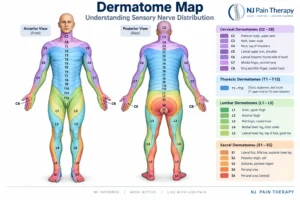
Pain That Shoots Into the Buttock or Leg
Pain that travels from the lower back into the buttock or leg raises more concern for nerve involvement.
That pattern is commonly associated with sciatica or another form of nerve root irritation.
If coughing or sneezing causes a sharp pain that shoots down the leg, that is a different pattern from soreness that stays in one small area of the lower back.
You can learn more about what this symptom may mean in our guide to pain that radiates down the leg.
Back Pain With Numbness, Tingling, or Weakness
Numbness, tingling, and weakness deserve more attention because they may indicate that a nerve is being irritated or compressed.
These symptoms may occur in the buttock, thigh, calf, foot, or toes depending on which nerve is involved.
Mild tingling does not automatically mean there is a serious problem, but worsening weakness should not be ignored.
If you notice increasing difficulty lifting the foot, standing, walking, or controlling the leg, it is worth being evaluated promptly rather than assuming the pain is simply muscular.
Does Pain When Coughing Mean You Have a Herniated Disc?
No. Pain with coughing or sneezing does not automatically mean you have a herniated disc.
A strained muscle, irritated joint, or other mechanical problem can also hurt when the body suddenly tightens during a cough or sneeze.
A herniated disc becomes more relevant when the pain has a clear nerve-related pattern, such as:
- Pain that shoots into the buttock or leg
- Burning or electrical pain
- Numbness or tingling
- Weakness in the leg or foot
The pattern matters more than the cough itself. If the pain stays localized in the back, a muscle or joint problem may be more likely. If it travels along the leg or comes with neurological symptoms, nerve irritation deserves more attention.
When Should Back Pain From Coughing or Sneezing Be Evaluated?
Back pain that only happens once or twice and improves quickly may not require much attention.
It is worth getting evaluated when the pain:
- Persists instead of improving
- Keeps returning
- Is becoming more severe
- Radiates into the buttock or leg
- Includes numbness or tingling
- Is associated with weakness
- Interferes with walking, sleep, work, or normal daily activity
A physician can help determine whether the pain is coming from a muscle, disc, joint, nerve, or another structure.
Symptoms That Need Prompt Medical Attention
Severe back pain with certain neurological symptoms should be evaluated urgently.
Seek prompt medical attention for symptoms such as:
- New bowel or bladder problems
- Numbness around the groin or saddle area
- Significant or worsening leg weakness
These symptoms can occur with serious nerve compression, including cauda equina syndrome, and should not be ignored.
How is Back Pain Triggered by Coughing or Sneezing Diagnosed?
The goal is not simply to confirm that coughing hurts. The physician is trying to determine what structure is being irritated and why the pain is happening.
Symptom History
The evaluation usually starts with questions about how the pain behaves.
Your doctor may ask:
- Where does the pain start?
- Does it stay in the back or travel?
- Does coughing, sneezing, laughing, or straining reproduce it?
- Do you have numbness, tingling, or weakness?
- How long has the pain been present?
- Did it begin after an injury, lifting, exercise, or another activity?
- What movements make it better or worse?
These details help distinguish more localized mechanical pain from symptoms that may involve a nerve.
Physical Examination
A physical examination may include checking:
- Spinal movement
- Muscle tenderness
- Leg strength
- Reflexes
- Sensation
- Walking or balance
- Movements that reproduce the pain
If the symptoms travel into the leg, the examination may focus more closely on signs of nerve irritation or compression.
Imaging When Appropriate
Imaging is not automatically necessary every time someone has back pain when coughing or sneezing.
Depending on the symptoms and examination findings, a physician may recommend an X-ray, MRI, or another imaging study to look for structural changes.
An MRI may be particularly useful when there are persistent symptoms suggesting a disc or nerve problem. Imaging findings still need to be interpreted alongside the patient’s symptoms and physical examination.
How Is Back Pain When Coughing or Sneezing Treated?
Treatment depends on the underlying cause.
For some patients, appropriate options may include:
- Activity modification
- Physical therapy
- Appropriate medications
- Targeted injections
- Other interventional pain treatments when conservative care is not enough
A simple muscle strain and an irritated spinal nerve are not treated exactly the same way, which is why identifying the source matters.
The cough or sneeze is usually the trigger, not necessarily the underlying problem that needs treatment.
If a spinal disc, irritated nerve, joint, or another structure is causing the pain, treatment should focus on that source rather than simply trying to avoid coughing or sneezing.
Is Back Pain When Coughing or Sneezing Something to Worry About?
Back pain that briefly appears during a cough or sneeze can come from something relatively simple, such as a muscle strain. However, repeated sharp pain, pain that travels into the leg, numbness, tingling, or weakness can suggest that a spinal disc or nerve is involved and deserves evaluation.
The important thing is to look at the full symptom pattern rather than one movement by itself.
If coughing, sneezing, or everyday movement repeatedly triggers back pain, the Center for Regenerative Therapy & Pain Management can evaluate the source of your symptoms and discuss appropriate pain management treatments in New Jersey.
Schedule an appointment if persistent or worsening back pain is interfering with your daily life.