Numbness in one finger, tingling along the outside of the foot, or pain traveling down a leg can seem disconnected from the spine. But those symptoms may follow the path of a specific spinal nerve.
Dermatomes help explain why.
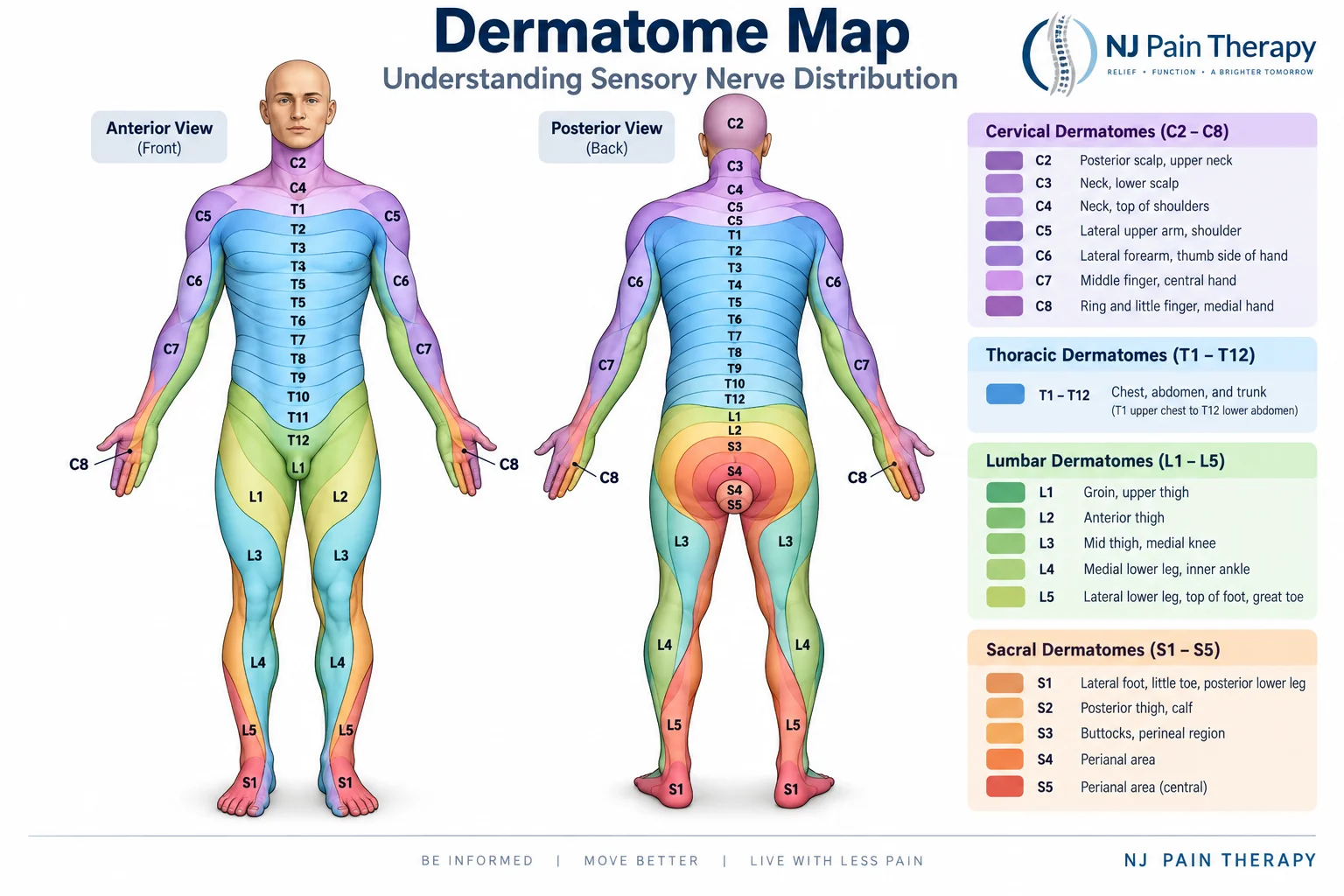
A dermatome is an area of skin associated with a particular spinal nerve root. Because spinal nerves carry sensory information between the body and the brain, irritation or compression of a nerve root can sometimes cause pain, numbness, tingling, or other changes in a recognizable area of skin.
Dermatome maps can be useful when evaluating nerve related symptoms, but they are not exact blueprints. There is overlap between neighboring dermatomes, and the pattern can vary somewhat from one person to another.
If pain, numbness, tingling, or radiating symptoms continue, exploring pain treatments in New Jersey can help determine whether a spinal nerve or another source of pain may be involved.
What Are Dermatomes?
Quick Answer
Dermatomes are areas of skin connected to specific spinal nerve roots.
Spinal nerves carry signals between the body and the brain. Different nerve roots are associated with sensation in different areas of the skin, and those areas are known as dermatomes.
Doctors can sometimes use the location of symptoms to help determine which nerve may be irritated.
For example, numbness in part of the hand may point toward a cervical nerve, while numbness in part of the foot may suggest involvement of a lumbar or sacral nerve.
Dermatomes cover most of the body. The face is different because much of its sensation is carried through nerves that do not connect to the spinal cord in the same way.
A simple way to think about dermatomes is as a map of sensory nerve connections across the body.
Why Do Dermatomes Matter?
Dermatomes are useful because the place where you feel a symptom is not always the place where the problem begins.
A person may feel pain or numbness in the hand, leg, or foot even though the irritated nerve is located closer to the spine.
Dermatome patterns can help doctors connect those two locations.
Pain Can Be Felt Away From the Spine
A nerve may become irritated in the neck or lower back while symptoms show up farther away.
Those symptoms may be felt in areas such as:
- The arm
- The hand
- The leg
- The foot
- The fingers
- The toes
This happens because the same spinal nerves carry sensory signals between those areas and the brain.
For example, irritation of a nerve root in the lower back may cause symptoms that travel into the leg or foot. A nerve problem in the neck may cause symptoms that extend into the arm or fingers.
Symptom Location Can Provide Clues
The location of pain, numbness, tingling, or burning can sometimes help narrow down which nerve root may be involved.
If symptoms consistently follow a certain path, a doctor may compare that pattern with known dermatome distributions.
This does not mean that a dermatome map can diagnose the problem on its own.
Dermatomes are clues, not a diagnosis.
Doctors still need to consider the patient’s medical history, symptoms, physical examination, and other testing when appropriate.
How Are Dermatomes Organized?
Dermatomes are organized according to the spinal nerves that supply them.
Those nerves are grouped by the region of the spine where they exit.
Cervical Dermatomes
Cervical nerves originate in the neck.
Their dermatomes mainly involve areas around the:
- Neck
- Shoulders
- Arms
- Hands
- Fingers
These patterns can be especially useful when someone has neck pain along with numbness, tingling, or pain extending into the arm or hand.
Thoracic Dermatomes
Thoracic nerves come from the middle portion of the spine.
Their dermatomes mainly cover areas around the:
- Chest
- Upper and middle back
- Abdomen
Many thoracic dermatome patterns wrap around the torso from the back toward the front of the body.
Lumbar Dermatomes
Lumbar nerves originate in the lower back.
Their dermatomes extend into areas that can include the:
- Hips
- Thighs
- Knees
- Lower legs
- Feet
These patterns are especially relevant when someone has lower back pain combined with numbness, tingling, or pain traveling into the leg.
Sacral Dermatomes
Sacral nerves are located lower in the spine and are associated with areas including the:
- Buttocks
- Back of the legs
- Calves
- Ankles
- Feet
- Toes
Lumbar and sacral dermatomes are particularly important when evaluating symptoms such as sciatica, leg numbness, or foot tingling.
What Do Cervical Dermatomes Tell Doctors?
Cervical dermatomes can help doctors understand symptoms that travel from the neck into the shoulder, arm, hand, or fingers.
Different cervical nerve roots are associated with different areas of sensation.
Numbness or Tingling in the Hand
Certain cervical nerve roots connect with different parts of the hand and fingers.
Depending on the nerve involved, sensory changes may affect areas such as the:
- Thumb
- Index finger
- Middle finger
- Ring finger
- Pinky
The pattern can provide useful information, but it should not be treated as perfectly exact.
Neighboring dermatomes overlap, so real symptoms do not always stay inside the lines shown on an anatomy diagram.
A person may also have more than one irritated nerve or another condition affecting sensation in the hand.
Cervical Radiculopathy
Cervical radiculopathy occurs when a nerve root in the neck becomes irritated or compressed.
Symptoms can extend from the neck into the shoulder, arm, hand, or fingers and may include pain, tingling, numbness, or weakness.
Understanding cervical radiculopathy symptoms and where they travel can help doctors determine which cervical nerve may be involved.
Dermatome patterns are one piece of that evaluation.
What Do Lumbar and Sacral Dermatomes Tell Doctors?
Lumbar and sacral dermatomes are especially relevant when someone has lower back pain, sciatica, leg numbness, or symptoms that extend into the foot.
These nerve roots supply sensation to different areas of the lower body.
Leg Pain and Numbness
Irritation of a lumbar nerve root can produce symptoms farther down the leg.
Depending on the nerve involved, pain, tingling, or numbness may affect the:
- Thigh
- Knee
- Shin
- Calf
- Foot
- Toes
The location and direction of the symptoms can help doctors understand which nerve may be involved.
Foot Numbness and Tingling
Some lumbar and sacral nerve roots extend into different parts of the foot.
That is why someone can experience numbness or tingling in the foot even when the foot itself has not been injured.
The source of the problem may actually be a nerve near the lower spine.
This is also why symptoms such as sciatica causing foot numbness can make sense anatomically. The irritation may begin near the spine while the numbness is felt much farther down the nerve pathway.
Sciatica
Sciatica describes symptoms caused by irritation or compression of nerves that travel from the lower spine into the buttock and leg.
Pain may be the most familiar symptom, but sciatica can also cause:
- Tingling
- Numbness
- Burning
- Weakness
Dermatome patterns can help physicians determine whether those symptoms appear to follow a particular lumbar or sacral nerve distribution.
The pattern alone does not confirm sciatica, but it can provide an important clue when combined with the rest of the patient’s symptoms and examination.
What Symptoms Can Follow a Dermatome?
When a spinal nerve is irritated or compressed, symptoms may show up in the area of skin connected to that nerve.
Common symptoms can include:
- Pain
- Burning
- Tingling
- Numbness
- Pins and needles
- Reduced sensation
- Changes in temperature sensation
The exact feeling can vary from person to person. One patient may notice burning pain, while another may mainly feel numbness or tingling.
Dermatomes Are Primarily About Sensation
Dermatomes describe sensory regions of the skin.
That means they are mainly used to understand changes in things like pain, touch, numbness, tingling, and temperature sensation.
Muscle strength is evaluated somewhat differently. Movement is associated with nerve pathways known as myotomes.
Doctors may look at both sensation and strength when evaluating a possible nerve problem, but dermatome patterns specifically help show where sensory symptoms may be coming from.
What Conditions Can Affect Dermatome Patterns?
Several spinal conditions can irritate or compress a nerve root and create symptoms that follow a dermatome pattern.
Herniated Discs
A herniated disc can press against or irritate a nearby spinal nerve root.
When that happens, a patient may feel pain, tingling, numbness, or burning along the area supplied by that nerve.
The exact pattern depends on which nerve is affected.
Learn more about how disc herniations can affect nearby spinal nerves.
Spinal Stenosis
Spinal stenosis narrows the space around nerves in the spine.
That narrowing can contribute to pain, numbness, tingling, or weakness that travels into the arms or legs.
Dermatome patterns may help doctors understand which nerve roots are being affected in patients with spinal stenosis.
Sciatica and Lumbar Radiculopathy
Sciatica and lumbar radiculopathy involve irritation or compression of nerves in the lower spine.
Symptoms may travel through the buttock and into the leg or foot.
Depending on the nerve involved, a patient with sciatica may notice pain, tingling, numbness, or burning in a specific area of the leg or foot.
Cervical Radiculopathy
Cervical radiculopathy involves a nerve root in the neck.
Symptoms may extend into the shoulder, arm, hand, or fingers and can include pain, tingling, numbness, or weakness.
Understanding cervical radiculopathy symptoms and where they travel can help physicians compare a patient’s symptoms with common cervical dermatome patterns.
Do Dermatome Maps Always Match Symptoms Exactly?
No.
Dermatome maps are helpful clinical tools, but they are not perfectly precise.
Real people do not always experience symptoms in the exact shapes shown on an anatomy chart.
Dermatomes Can Overlap
Neighboring spinal nerves can share some sensory territory.
That means pain or numbness may cross into an area associated with another nearby nerve.
A patient may also feel symptoms across more than one dermatome.
This overlap is one reason doctors do not diagnose a nerve problem based on a dermatome map alone.
People Can Have Slightly Different Patterns
Symptoms can vary because of factors such as:
- Natural anatomical differences
- More than one irritated nerve
- The severity of nerve compression
- Other nerve conditions
- Multiple sources of pain
Dermatome charts can provide useful clues, but they should not be used for self diagnosis.
The full symptom pattern still needs to be evaluated in context.
How Do Doctors Use Dermatomes to Evaluate Nerve Pain?
Dermatomes can help doctors make sense of where symptoms begin and where they travel.
They are usually one part of a broader evaluation.
Asking Where the Symptoms Travel
A doctor may ask questions such as:
- Where did the pain begin?
- Where does it travel?
- Which fingers or toes feel numb?
- Is one side affected?
- Does tingling follow a consistent path?
These details can help identify whether the symptoms appear to match a particular spinal nerve distribution.
Testing Sensation
During a physical exam, a doctor may compare sensation in different parts of the arms, legs, hands, or feet.
They may also evaluate:
- Strength
- Reflexes
- Walking
- Spinal movement
These findings can help show whether a nerve problem is affecting sensation, movement, or both.
Imaging and Other Testing
When more information is needed, testing may include:
- MRI
- CT imaging
- EMG testing
These tests can help identify structural or nerve related problems that may be causing symptoms.
A dermatome pattern is only one part of the picture.
Doctors may also consider the patient’s medical history, symptom progression, physical examination, and imaging or nerve testing when appropriate.
When Should Numbness or Tingling Be Evaluated?
Occasional tingling does not always mean something serious is wrong.
Persistent or worsening symptoms deserve more attention.
Consider speaking with a physician if:
- Numbness continues
- Tingling keeps returning
- Pain travels down an arm or leg
- Symptoms interfere with walking or daily activity
- Weakness develops
- Symptoms are progressively getting worse
- Conservative measures are not helping
A medical evaluation can help determine whether a spinal nerve is involved or whether another condition may be causing the symptoms.
Symptoms That Need Prompt Attention
Some neurological symptoms should be evaluated promptly.
These include:
- Rapidly worsening weakness
- Significant loss of sensation
- Loss of bowel or bladder control
- Numbness around the saddle or groin area
- Severe symptoms affecting both legs
These symptoms can suggest more significant nerve involvement and should not be ignored.
Conclusion
Dermatomes are areas of skin associated with specific spinal nerve roots.
They help explain why a nerve problem in the spine can cause pain, numbness, tingling, or other sensory changes somewhere else in the body.
Dermatome patterns can help doctors narrow down which spinal nerve may be involved, but they are not perfectly precise.
They are most useful when combined with the patient’s full symptoms, physical examination, medical history, and testing when needed.
If persistent pain, numbness, tingling, or radiating symptoms may be related to a spinal nerve, exploring pain management services in New Jersey can help determine the source of the symptoms and which treatment options may be appropriate.