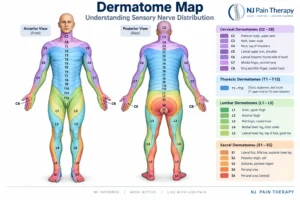

What is referred pain? Referred pain is pain you feel in one area of the body even though the actual source of the problem is somewhere else.
That can make symptoms confusing. You may feel pain in your hip, shoulder, arm, leg, or jaw, but the real issue may be coming from the spine, a joint, a nerve pathway, a muscle, or another body system.
Referred pain does not mean the pain is imaginary. The pain is real. The confusing part is that the nervous system can send or interpret pain signals in a way that makes pain show up away from the source.
This is why pain location does not always tell the full story. Treating only the area that hurts may not solve the problem if the actual pain source is somewhere else.
If pain keeps showing up in one area but the source is unclear, The Center for Regenerative Therapy and Pain Management offers pain management treatments in New Jersey to help evaluate your symptoms and explore your options.
How Referred Pain Works
The nervous system is connected
Your nerves are part of a connected communication system.
Nerves throughout the body send messages to the spinal cord and brain. In some cases, different areas of the body can share overlapping nerve pathways. When this happens, the brain may have trouble identifying exactly where the pain signal started.
That is why pain can appear in a place that was not directly injured.
For example, a problem in the low back may be felt in the buttock, hip, thigh, or leg. A problem in the neck may be felt near the shoulder blade, arm, head, or jaw. The painful area matters, but it may not be the true source.
Referred pain vs. primary pain
Primary pain is pain felt where the injury, irritation, or inflammation actually happens.
For example, if you twist your ankle and your ankle hurts, that is primary pain. The pain and the problem are in the same place.
Referred pain is different. With referred pain, the pain is felt away from the source. A spine issue may cause pain into the buttock, hip, thigh, shoulder, or arm, even though those areas were not directly injured.
This is one reason diagnosis matters. The body may be pointing to one area, while the real pain generator is somewhere else.
Referred pain vs. radiating nerve pain
Referred pain and radiating nerve pain are often confused, but they are not always the same thing.
Radiating nerve pain often follows a nerve pathway. It may feel like burning, tingling, numbness, shooting pain, or weakness. This can happen when a nerve is irritated, compressed, or inflamed.
Referred pain may feel more dull, achy, deep, vague, or hard to pinpoint. It may spread into a nearby or related area without following a clear nerve path.
That said, patients do not need to figure this out alone. A medical evaluation can help determine whether symptoms are coming from referred pain, nerve irritation, a joint problem, a muscle issue, or another cause.
What Does Referred Pain Feel Like?
Common symptoms
Referred pain can feel different from person to person.
It may feel like:
- Dull aching
- Burning
- Tingling
- Sharp pain
- Stabbing pain
- Radiating discomfort
- Deep pressure
- Pain that spreads
- Pain that is hard to locate
Some people can point to one exact spot. Others feel like the pain covers a wider area or moves around. Referred pain may also come and go depending on position, movement, activity, inflammation, or the underlying condition causing it.
Why referred pain can be confusing
Referred pain can be frustrating because the painful area may not be the injured area.
You may treat the spot that hurts with stretching, massage, rest, heat, or ice, but the pain keeps coming back. That does not mean those treatments are useless. It may simply mean they are not addressing the true source.
Patients may also describe the pain as random, strange, or hard to explain. One day it may feel like hip pain. Another day it may feel like back, thigh, or buttock pain.
The true source may be in the spine, joint, muscle, nerve, or another body system. Finding that source is what helps guide the right treatment plan.
Common Examples of Referred Pain
Low back pain felt in the hip, buttock, or leg
Low back problems can sometimes be felt in the buttock, hip, thigh, or leg.
This can be confusing because it may feel like a hip or leg injury, even when the source is related to the low back. Pain may come from joints, discs, nerves, muscles, or other spinal structures.
For example, a person may feel pain deep in the buttock or side of the hip and assume the hip joint is the problem. In some cases, the low back or sacroiliac area may be involved instead.
Neck pain felt in the shoulder, arm, or head
Neck problems can show up in areas beyond the neck.
Some people feel pain near the shoulder blade. Others notice headaches, arm discomfort, upper back tension, or jaw-area symptoms. Because of this, a person may assume they have a shoulder problem when the neck is actually part of the issue.
This is especially common when pain changes with neck movement, posture, or long periods of sitting at a desk.
Hip pain felt in the groin, back, or knee
Hip joint pain does not always stay in the hip.
It may be felt in the groin, buttock, low back, thigh, or knee. This is why knee pain is not always caused by the knee itself.
If someone has knee pain without a clear knee injury, the hip or low back may need to be considered. The same is true for groin or buttock pain that does not improve with basic care.
Internal organ pain felt elsewhere
Some referred pain patterns can be more serious.
Heart-related pain may be felt in the arm, jaw, shoulder, teeth, or upper back. Gallbladder problems may refer pain near the right shoulder blade. Pancreas problems may cause pain that is felt in the back.
These symptoms should not be ignored. If pain comes with chest pressure, shortness of breath, dizziness, sweating, sudden weakness, or other concerning symptoms, seek emergency care.
Why Referred Pain Happens
Nerve pathway overlap
Referred pain often happens because nerve pathways overlap.
Nerves from different areas may enter the spinal cord near the same levels. When pain signals travel through these shared pathways, the brain may misread where the signal started.
The result is pain that feels like it is coming from one area, even though the source is somewhere else.
This is not a failure of the body. It is a normal part of how complex the nervous system can be.
Muscle compensation and movement patterns
Referred pain can also be connected to movement patterns.
Weakness, overuse, posture, or repetitive motion can make one area of the body compensate for another. Over time, the overworked area may start to hurt, even though it is not the original problem.
This is common in athletes and active adults. For example, hip weakness may contribute to knee pain. A shoulder issue may be linked to neck or upper back mechanics. A runner may feel pain in one area because another area is not moving or supporting the body well.
In these cases, treating only the painful spot may not create lasting relief. The movement pattern also needs to be understood.
Spine and joint problems
Spine and joint problems can create confusing pain patterns.
Neck and back conditions may refer pain into the shoulders, arms, buttocks, hips, thighs, or legs. Sacroiliac joint issues, facet joint irritation, disc problems, and nerve irritation can all cause pain that does not stay neatly in one spot.
This is why a detailed exam matters. The goal is to figure out whether pain is coming from the spine, a joint, a nerve, a muscle, or another source.
When Referred Pain May Be Serious
Red flags to watch for
Some referred pain needs prompt medical attention.
Watch for red flags such as:
- Chest pain
- Shortness of breath
- Dizziness
- Sudden jaw, shoulder, arm, or upper back pain
- New numbness, tingling, or weakness
- Severe unexplained pain
- Pain after an injury
- Pain that keeps worsening
Pain does not have to be dramatic to matter. If symptoms feel unusual, severe, sudden, or different from your normal pain pattern, it is better to get checked.
When to seek emergency care
Call 911 or seek emergency care if symptoms could involve a heart attack, stroke, severe breathing issue, or sudden neurological problem.
This includes chest pressure, shortness of breath, sudden weakness, facial drooping, trouble speaking, dizziness, fainting, or sudden severe pain in the jaw, shoulder, arm, upper back, or chest.
For non-emergency pain that keeps returning, spreading, or affecting daily life, a pain management evaluation may help identify the source and next steps.
How Doctors Diagnose Referred Pain
Medical history and symptom review
Diagnosing referred pain usually starts with a detailed conversation about your symptoms.
A doctor may ask where you feel the pain, when it started, and whether it came on suddenly or gradually. They may also ask what makes it better or worse, such as movement, sitting, standing, bending, lifting, eating, sleeping position, or activity.
It also helps to know whether the pain moves, spreads, or changes throughout the day. For example, low back pain that spreads into the hip or thigh may point to a different source than pain that stays in one small area.
Your injury history matters too. A recent fall, car accident, sports injury, surgery, or repetitive strain can all provide clues.
A doctor will also ask about numbness, tingling, weakness, burning, balance changes, headaches, chest symptoms, or other concerns. These details help separate referred pain from nerve compression, joint problems, muscle injuries, and more serious medical conditions.
Physical examination
A physical exam helps connect your symptoms to how your body moves and responds.
Your doctor may check range of motion to see whether certain movements trigger pain. They may test strength, reflexes, and sensation to look for signs of nerve involvement. Posture, walking pattern, muscle tightness, and movement habits may also be reviewed.
Tenderness and pain triggers can also provide useful information. Sometimes pressing on one area causes pain somewhere else. Other times, moving the neck, back, hip, or shoulder can reproduce symptoms in a different part of the body.
The goal is not just to find where it hurts. The goal is to understand what may be causing the pain.
Imaging or testing when needed
Sometimes, a physical exam is enough to guide the next step. Other times, imaging or testing may be needed.
Depending on the symptoms, a doctor may recommend X-rays, MRI, CT scans, ultrasound, bloodwork, or other testing. Imaging can help evaluate bones, joints, discs, soft tissues, inflammation, or structural problems.
In some cases, diagnostic injections may be used when appropriate. These can help determine whether a specific joint, nerve, or structure is contributing to the pain.
Not every patient needs every test. The right approach depends on the symptoms, exam findings, medical history, and level of concern.
How Referred Pain is Treated
Treating the source, not just the painful area
Referred pain is treated by finding and addressing the true source of the pain.
This matters because treating only the area where pain is felt may not solve the problem. For example, if knee pain is actually coming from the hip, treating only the knee may lead to temporary or incomplete relief. If shoulder blade pain is related to the neck, the shoulder may not be the main issue.
Long-term relief usually depends on identifying the actual pain generator. That source may be the spine, a joint, a nerve, a muscle, or another underlying condition.
Once the source is clearer, the treatment plan can be more focused.
Conservative options
Many cases of referred pain start with conservative care.
This may include activity changes, physical therapy, stretching and strengthening, posture improvements, heat or ice, and medication when appropriate.
Physical therapy may be especially helpful when referred pain is connected to movement patterns, weakness, tightness, or compensation. For example, strengthening the hip and core may help with certain low back or leg pain patterns. Improving neck and upper back mechanics may help with shoulder blade or headache symptoms.
The goal is to reduce irritation, improve movement, and address the factors that may be feeding the pain.
Pain management treatment options
When symptoms continue or when the pain source is more specific, pain management treatments may be considered.
Depending on the condition, options may include Medication Management, Nerve Blocks, Steroid Injections, Epidural Injections, Radiofrequency Ablation, Spinal Cord Stimulators, Plasma Injections, or Hyaluronic Acid Gel Injections.
These treatments are not used for every case of referred pain. They may be considered when symptoms point to a specific pain source that can be treated through pain management care.
The right treatment depends on what is causing the pain, how long symptoms have been present, whether nerves or joints are involved, and how much pain is affecting daily life.
When Should You See a Pain Management Specialist?
You should consider seeing a pain management specialist if pain lasts more than a few weeks, keeps returning, or continues to interfere with your life.
Pain that is severe, worsening, spreading, or showing up in another area should also be evaluated. This is especially true if pain radiates into the arm or leg, or if numbness, tingling, burning, or weakness develops.
You may also benefit from care if conservative treatment is not helping. If rest, stretching, over-the-counter medication, physical therapy, or activity changes have not improved your symptoms, the pain source may need a closer look.
Referred pain can be hard to figure out on your own. If you are unsure where the pain is coming from, or if pain affects sleep, work, walking, exercise, or daily activities, it may be time for a more complete evaluation.
The Center for Regenerative Therapy and Pain Management sees patients in Shrewsbury and Toms River, helping people better understand their symptoms and explore treatment options based on the source of their pain.
Frequently Asked Questions About Referred Pain
What is referred pain?
Referred pain is pain felt in one area of the body even though the actual source is somewhere else.
For example, a problem in the low back may be felt in the hip, buttock, or thigh. A neck issue may feel like shoulder, arm, or headache pain.
What causes referred pain?
Referred pain can happen when overlapping nerve pathways make the brain interpret pain as coming from a different area than the true source.
The source may involve the spine, joints, muscles, nerves, inflammation, or another body system.
Is referred pain real?
Yes. Referred pain is real physical pain.
The confusing part is that the pain is felt away from the actual problem. This can make it harder to understand where symptoms are coming from without a proper evaluation.
What are common examples of referred pain?
Common examples include low back pain felt in the hip or thigh, neck pain felt in the shoulder or arm, hip pain felt in the knee, and heart-related pain felt in the arm or jaw.
Referred pain can happen in many areas of the body, which is why the pattern of symptoms matters.
Can referred pain come from the spine?
Yes. Spine problems in the neck or low back can refer pain into the shoulder, arm, buttock, hip, thigh, or leg.
This can happen when joints, discs, muscles, or nerves around the spine become irritated.
How do you treat referred pain?
Treatment depends on the true source of the pain.
The goal is to identify and treat the underlying pain generator, not only the area where the pain is felt. Treatment may include conservative care, physical therapy, medication when appropriate, or pain management treatments depending on the diagnosis.
When should I see a doctor for referred pain?
You should get evaluated if pain is severe, unexplained, worsening, spreading, lasting more than a few weeks, or associated with numbness, tingling, weakness, chest pain, dizziness, or shortness of breath.
Seek emergency care right away if symptoms could involve a heart attack, stroke, severe breathing issue, or sudden neurological problem.
Conclusion
Referred pain can be confusing because the place that hurts is not always the true source of the problem.
That does not mean the pain is imaginary. Referred pain is real, but pain location does not always tell the full story. The key is figuring out where the pain is actually coming from and why it is happening.
Treatment should focus on the underlying pain generator, not just the area where symptoms show up.
If you are dealing with pain that keeps moving, spreading, or showing up in an unexpected place, The Center for Regenerative Therapy and Pain Management offers pain management treatments in New Jersey to help identify the source and create a plan that fits your symptoms.