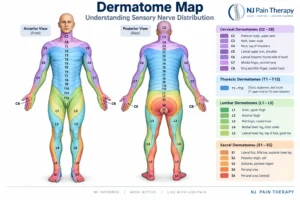
Most people describe pain by intensity: it is a 7 out of 10, it feels terrible, it is ruining my day. That is real, but it is not how treatment decisions get made. Doctors make decisions based on pattern and location: where the pain starts, where it travels, what reliably triggers it, and what reliably relieves it.
A pain map is just a structured way to capture those details. It tracks where pain begins, where it travels, and what makes it worse or better, so the provider can narrow the likely pain generator instead of throwing random treatments at the wall.
In this guide, you will learn what doctors are actually looking for during a pain map visit, how that information leads to specific treatment paths, and how to prep so the visit is genuinely useful. If pain is limiting work, sleep, or daily life, schedule an evaluation for pain treatment in New Jersey so you can confirm the driver and get a stepwise plan.
Quick Summary
What a pain map visit is
A pain map visit is a focused evaluation that turns symptoms into a pattern so the likely pain generator can be identified.
What it helps doctors do
It helps separate nerve pain from joint or muscle pain, avoid random injections, and choose the right next step: rehab, meds, diagnostic blocks, or procedures.
What you should walk out with
You should leave with the most likely pain generator, a clear stepwise plan, and guidance on what to track and when to follow up.
What is a “pain map” in plain English
Pain location
This is more specific than “my back hurts.” Providers want the exact spot and depth: midline versus one side, joint line versus muscle band, deep ache versus surface tenderness. Those details change the whole differential.
Radiation pattern
Does it travel into the arm, leg, groin, buttock, shoulder blade, or foot. Radiation patterns are often the clue that separates nerve irritation from local joint or soft tissue pain.
Symptom type
Aching feels different than sharp. Burning feels different than electric or zapping. Numbness, tingling, weakness, and heaviness matter because they suggest nerve involvement or sensitivity patterns that need different treatment choices.
Timing and behavior
Is it constant or intermittent. Worse in the morning or at night. Does it flare after activity, and if so, does it flare immediately or the next day. Behavior over time is often more diagnostic than a single pain score.
What doctors are actually listening for
Red flags first
Before anything else, they are screening for urgent issues: new weakness, bowel or bladder changes, fever, major trauma, or anything that suggests a more serious condition needs to be ruled out fast.
Pattern clues that narrow the generator
Once red flags are cleared, the listening becomes pattern based. They are looking for clues that point toward disc or nerve irritation, facet patterns, SI joint patterns, stenosis patterns, myofascial trigger point patterns, or “masqueraders” like hip and shoulder problems that get mislabeled as spine pain.
How the pain map connects to common pain generators
Nerve root irritation: radicular pain
Sciatica or arm radiation patterns often point toward a nerve root being irritated. The pain tends to travel in a line and may include tingling, numbness, or weakness. This is a different category than local back or neck aching, and it leads to different next steps.
Facet mediated pain
Facet pain is typically more localized neck or back pain that gets worse with extension and rotation, like looking up, turning the head, or leaning back. It is often stiff and positional rather than electric down a limb.
SI joint mediated pain
SI joint pain often shows up as buttock dominant pain and can flare with transitions and stairs. It is commonly one sided. It can mimic sciatica because it can refer into the hip and thigh, which is why pattern testing matters.
Stenosis patterns
Stenosis often shows up as shrinking walking tolerance. Symptoms build with standing or walking and improve when you sit or lean forward. Leg heaviness and cramping are common clues, not just “back pain.”
Myofascial pain
Myofascial pain involves tender bands, trigger points, and referral patterns. Stress and guarding overlap here, because tight muscles are a common protection response when pain persists.
Joint driven pain
Hip problems can show up as groin or front thigh pain and get mislabeled as back pain. Shoulder problems can mimic neck and upper back pain. Knee pain can be referred or secondary to hip or back mechanics, depending on the pattern.
The exam: how doctors test the map
Movement testing
The provider will test which positions reproduce symptoms and where. This helps confirm whether pain is mechanical, nerve driven, joint driven, or muscle driven.
Neurologic screen
Strength, sensation, and reflexes matter because they can show true nerve involvement and change urgency and next steps. A neurologic deficit is treated differently than pain alone.
Provocative tests
These are pattern specific tests that stress certain pathways. Nerve tension tests can support nerve irritation patterns. Facet loading tests can support facet pathways. SI joint provocation testing is often most useful as a cluster concept. Hip screening tests help avoid treating “back pain” that is really hip driven.
Imaging: when it matters and how it is used
Imaging is evidence, not the verdict
Imaging findings are common even in people without symptoms. That is why a scan does not automatically equal a diagnosis. Imaging has to match your pattern and exam to be meaningful.
When imaging changes decisions
Imaging tends to matter most when symptoms persist, when there are neurologic deficits, and when planning a procedure safely. The goal is not to collect images, the goal is to make better decisions.
X ray vs MRI vs CT
X rays are often used for alignment and arthritis context. MRI is best for discs, nerves, soft tissue, and stenosis detail. CT is often used for bone detail or when MRI is not possible in certain situations.
How doctors translate the pain map into treatment choices
The stepwise model
Good pain management starts conservative and escalates based on response. The plan is not random, it is built around the generator and what changes function.
When PT is the best first step
If the pattern is mechanical and there are no red flags, PT is often the best first step because it builds tolerance, stability, and movement confidence. A pain map helps PT get targeted instead of generic.
When meds are discussed
Medication discussions are often non opioid focused, with short term support when needed. Nerve pain meds may be discussed when the pattern fits, not just because pain is severe.
When injections enter the plan and why
Epidural injections often fit radiating nerve root patterns when inflammation is blocking progress. Nerve blocks are often used to confirm facet or SI pathways. Steroid injections fit inflammation driven joint patterns in the right case. PRP or hyaluronic acid gel injections may be considered for select joint or soft tissue targets, depending on diagnosis, goals, and timeline.
When longer term procedures are discussed
Radiofrequency ablation is typically discussed after positive diagnostic blocks confirm the pathway. Neuromodulation options may be discussed for select chronic pain patterns when conservative and interventional steps do not create durable progress.
How to prepare for your pain map visit
Track 3 to 7 days
Track pain location and radiation, triggers and relief, sleep impact, and function limits. This is the fastest way to turn your story into a usable pattern.
Bring your history
Bring imaging reports, prior procedures, PT summary, and your medication list. If you do not have exact records, bring clinic names and dates.
Know your goals
Know what you want back: walking, work, sleep, sport, avoiding surgery, reducing meds. Goals help shape the plan and how success is measured.
Common mistakes that make the pain map less useful
Only talking about pain score
Pain score matters, but pattern is what drives the plan.
Not mentioning radiation or numbness
Radiation and neurologic symptoms often change the diagnosis category entirely.
Ignoring function and sleep
Function limits and sleep disruption are major decision drivers for escalation.
Assuming the MRI is the diagnosis
The MRI is only meaningful when it matches your pattern and exam.
Frequently Asked Questions About a Pain Map
What if my pain moves around
That is common. The goal is to identify the dominant pattern and the most limiting driver, then reassess as things change.
Do I need imaging before this visit
Not always. Many cases can be evaluated with pattern and exam first. Imaging is often used when it changes decisions or guides procedures safely.
What if PT made me worse
That can happen when the plan does not match the generator or the progression is too aggressive. Pain mapping helps refine the approach.
Will I get an injection that day
Usually no unless it was already planned. Most pain map visits focus on diagnosis and building the stepwise plan first.
Can I have more than one pain generator
Yes. Mixed drivers are common. Pain mapping helps prioritize which driver is dominant and most treatable first.
Conclusion
A pain map plus exam narrows the generator. Imaging confirms only when it matches the pattern. The best plans are stepwise and function first.
Schedule a pain management evaluation in New Jersey to complete a pain map visit and get a plan matched to your pattern rather than guesswork.