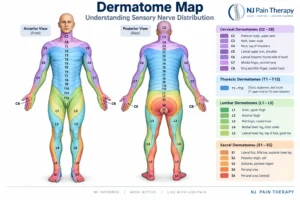

Finding the nerve responsible for pain is not always as simple as pointing to where it hurts. Several nerves can produce similar symptoms, and pain may travel into a different part of the body from where the problem actually begins.
Doctors usually combine your symptoms, physical examination, imaging, and diagnostic testing before recommending injections, nerve blocks, medication, or other treatments. The goal is to identify the most likely source of the pain so treatment can be as targeted as possible.
If you are living with ongoing nerve pain, explore pain management treatments in New Jersey at The Center for Regenerative Therapy & Pain Management.
Why Identifying the Right Nerve Matters
Not All Pain Comes From the Same Place
The location of your pain does not always reveal where the problem started.
For example, an irritated nerve in the lower back may cause pain, numbness, or tingling in the leg. A problem in the neck may create symptoms in the shoulder, arm, hand, or fingers.
This is known as referred or radiating pain. Because several nerves may affect nearby areas, doctors look at the full pattern of symptoms rather than focusing only on the spot that hurts.
Treating the Wrong Nerve Won’t Solve the Problem
Pain treatment works best when it targets the actual source.
An injection or nerve block placed in the wrong area may provide little relief, even when the treatment itself was performed correctly. This is why doctors do not usually choose a treatment based on symptoms alone.
The diagnosis comes first. Once the likely pain generator has been identified, the provider can recommend a treatment that makes sense for that specific nerve, joint, disc, or surrounding structure.
Doctors Start With Your Symptoms
Your description of the pain provides some of the first and most useful clues. Doctors look for patterns that may connect your symptoms to a particular nerve or part of the spine.
Where the Pain Is Located
Your provider will ask where the pain begins and where it travels.
This may include the:
- Neck
- Upper or lower back
- Shoulder
- Arm
- Hand or fingers
- Hip
- Leg
- Foot or toes
The exact path matters. Pain traveling down the back of the leg may suggest a different nerve than pain affecting the front of the thigh. Symptoms in certain fingers may also help narrow down which nerve is irritated.
What the Pain Feels Like
Nerve pain often feels different from muscle or joint pain.
Patients may describe it as:
- Burning
- Shooting
- Tingling
- Numbness
- Pins and needles
- Electric shock sensations
- Weakness
These descriptions do not confirm a diagnosis by themselves, but they help the doctor understand whether the pain may involve a nerve.
Weakness is especially important to report. It may indicate that the nerve is affecting how a muscle functions, not just how an area feels.
What Makes It Better or Worse
Doctors also ask which movements or activities change the pain.
Symptoms may become worse with:
- Walking
- Sitting
- Standing
- Bending
- Sleeping in certain positions
- Exercise
- Lifting
- Turning the neck or back
A person whose leg pain worsens while standing may have a different problem from someone whose symptoms increase after sitting. These patterns help the provider decide which structures and nerves need closer evaluation.
The Physical Examination Provides Important Clues
A physical examination allows the doctor to compare your symptoms with how your nerves and muscles are functioning.
Checking Strength and Reflexes
Different nerves help control different muscle groups. Your provider may ask you to push, pull, lift, grip, or move against resistance.
Muscle weakness in a specific area may help identify which nerve is affected.
Reflexes may also be checked at the knees, ankles, elbows, or other areas. A reduced or unusually strong reflex can provide another clue about where nerve irritation or compression may be occurring.
Testing Sensation
The doctor may compare how different areas respond to light touch, pressure, or temperature.
They will look for:
- Numbness
- Reduced feeling
- Tingling
- Pins and needles
- Differences between the left and right sides
Nerves often follow recognizable sensory patterns. The location of reduced sensation may help the provider narrow down which nerve is involved.
Reproducing Symptoms Safely
Certain movements can place gentle tension on a nerve or surrounding structure.
The doctor may use:
- Movement testing
- Range of motion exercises
- Leg or arm positioning
- Gentle pressure over specific nerves
- Neck, shoulder, back, or hip movements
The goal is not to make the patient hurt unnecessarily. It is to see whether a controlled movement recreates the same symptoms the patient experiences during daily life.
Imaging Helps Confirm the Diagnosis
Imaging can show structural changes that may be affecting a nerve. However, doctors usually interpret imaging alongside the patient’s symptoms and examination findings.
An abnormal scan does not always mean that the abnormality is causing the pain.
MRI Scans
An MRI provides detailed images of soft tissue, spinal discs, nerves, and the spinal canal.
It may help identify:
- Herniated or bulging discs
- Spinal stenosis
- Pinched nerves
- Inflammation
- Degenerative changes
- Pressure on the spinal cord or nerve roots
MRI findings are most useful when they match the patient’s symptoms. For example, a disc pressing on a particular nerve should generally correspond with the area of pain, numbness, or weakness.
CT Scans
A CT scan may be used when a doctor needs a detailed view of bones or certain structural changes.
It may also be recommended when:
- An MRI cannot be performed
- A patient has certain implanted devices
- Bone changes need closer evaluation
- Additional detail is needed after another imaging test
- A CT myelogram is appropriate
CT scans can help identify narrowing, fractures, bone spurs, and other conditions that may place pressure on a nerve.
X-Rays
X-rays are commonly used to evaluate bones and alignment.
They may show:
- Arthritis
- Bone spurs
- Disc space narrowing
- Fractures
- Changes in spinal alignment
- Degenerative changes
However, X-rays do not show nerves clearly. They may reveal structural problems that could contribute to nerve irritation, but they usually cannot identify the painful nerve by themselves.
Additional Tests That Help Identify the Problem
When symptoms, examination findings, and imaging do not provide a complete answer, doctors may use additional tests.
EMG and Nerve Conduction Studies
Electromyography, commonly called an EMG, evaluates how muscles respond to nerve signals.
A nerve conduction study measures how quickly and effectively electrical signals move through a nerve.
These tests may help determine:
- Whether a nerve is damaged
- Where the problem may be located
- How severe the nerve dysfunction may be
- Whether symptoms come from a nerve root or a peripheral nerve
- Whether another condition is affecting the muscles or nerves
EMG and nerve conduction studies may be recommended for ongoing numbness, tingling, weakness, or unclear symptoms.
Diagnostic Nerve Blocks
A diagnostic nerve block involves placing a small amount of numbing medication near a suspected nerve.
If the patient’s usual pain improves significantly for a limited period, it suggests that the targeted nerve may be contributing to the symptoms. If the pain does not change, the doctor may need to investigate another possible source.
Diagnostic nerve blocks can help guide decisions about future treatments, including longer-lasting injections, radiofrequency ablation, or other targeted procedures.
Sometimes More Than One Nerve Is Involved
Not every case has one clear pain source. Some patients have several conditions contributing to their symptoms at the same time.
Multiple Pain Sources Are Common
Chronic pain often develops from a combination of problems.
A patient may have a pinched spinal nerve along with arthritis, muscle tightness, or joint inflammation. Another person may have nerve irritation in both the neck and wrist, creating overlapping arm and hand symptoms.
This is why a treatment may improve part of the pain without eliminating every symptom. The provider may need to address each contributing source separately.
Conditions That Can Mimic Nerve Pain
Several conditions can create symptoms that feel similar to nerve pain, including:
- Arthritis
- Muscle injuries
- Tendon problems
- Joint disorders
- Trigger points
- Inflammation
- Circulation problems
For example, shoulder joint pain may spread into the upper arm and resemble a neck-related nerve problem. Hip arthritis may cause pain that feels similar to a lower back condition.
A careful evaluation helps separate true nerve pain from other conditions that may require a different treatment approach.
Once the Nerve Is Identified, Treatment Can Be More Targeted
Once the likely source of nerve pain is identified, treatment can focus more directly on the affected area.
The right option depends on the diagnosis, severity of symptoms, medical history, and how the patient has responded to previous care.
Medication Management
Medication may help reduce nerve pain, inflammation, muscle spasms, or related symptoms.
The type of medication depends on the condition. Some patients may benefit from anti-inflammatory medications, while others may need medications that specifically affect nerve pain signals.
Medication is often one part of a broader treatment plan rather than the only treatment used.
Epidural Steroid Injections
An epidural steroid injection delivers anti-inflammatory medication near irritated spinal nerves.
It may be considered for pain related to conditions such as:
- Herniated discs
- Spinal stenosis
- Sciatica
- Cervical radiculopathy
- Lumbar radiculopathy
The goal is to reduce inflammation around the nerve and improve pain, mobility, and function.
Nerve Blocks
A nerve block places medication near a specific nerve or group of nerves.
It may be used to help diagnose the source of pain, provide temporary relief, or guide the next step in treatment.
The amount and duration of relief can give the doctor useful information about whether the targeted nerve is contributing to the symptoms.
Radiofrequency Ablation (RFA)
Radiofrequency ablation uses controlled heat to interrupt pain signals from certain nerves.
It is commonly considered when diagnostic injections confirm that a specific nerve is carrying pain from an affected joint or area.
RFA does not treat every type of nerve pain. It is usually recommended only when the diagnosis and previous testing support its use.
Peripheral Nerve Stimulation
Peripheral nerve stimulation uses mild electrical signals to change how pain messages travel through a targeted peripheral nerve.
A small lead is placed near the affected nerve and connected to a stimulation system.
This option may be considered when pain is linked to a specific peripheral nerve and more conservative treatments have not provided enough relief.
Spinal Cord Stimulation
Spinal cord stimulation changes how pain signals are processed before they reach the brain.
It may be considered for certain chronic pain conditions, including persistent nerve pain that has not improved with other treatments.
Patients commonly complete a temporary trial before a permanent system is considered. The trial helps determine whether stimulation meaningfully reduces pain and improves function.
Regenerative Medicine Options
Regenerative medicine treatments, including platelet-rich plasma therapy, may be appropriate when pain involves injured joints, tendons, ligaments, or other supporting tissues.
These treatments are not designed to treat every type of nerve damage. However, they may help address surrounding tissue problems that contribute to pain or irritation in selected patients.
The doctor should first determine whether the symptoms are coming directly from a nerve or from another structure that may be affecting it.
When Should You See a Pain Management Specialist?
Occasional pain may improve with rest and conservative care. Persistent, worsening, or unexplained symptoms may require a more detailed evaluation.
Pain Lasts Longer Than Expected
Pain that continues beyond the expected recovery period should not be ignored.
Ongoing symptoms may indicate that a nerve remains irritated, compressed, or injured. A pain management specialist can look beyond the immediate symptoms and evaluate why the pain is continuing.
Numbness or Weakness Develops
Numbness, tingling, or weakness may suggest that a nerve is affecting sensation or muscle function.
These symptoms are especially important when they are new, worsening, or affecting only one side of the body.
Sudden or severe weakness, loss of bladder or bowel control, or numbness around the groin requires urgent medical attention.
Daily Activities Become Difficult
Consider seeking care when pain begins interfering with:
- Walking
- Working
- Driving
- Sleeping
- Exercising
- Lifting
- Household activities
Pain does not need to be unbearable before it deserves attention. A noticeable loss of function can be an important reason to seek an evaluation.
Previous Treatments Haven’t Helped
A pain management specialist may be able to look more closely at why previous treatments did not work.
The original diagnosis may need to be reviewed, another pain source may be involved, or the treatment may not have targeted the correct nerve.
A lack of improvement does not always mean that no treatment will help. It may mean that the next step requires a more focused diagnosis.
Frequently Asked Questions About Finding the Nerve Causing Pain
Can doctors tell which nerve is causing pain without surgery?
Yes. Surgery is usually not needed to identify the nerve causing pain.
Doctors often use the symptom pattern, physical examination, imaging, EMG testing, nerve conduction studies, and diagnostic injections to determine which nerve is most likely involved.
Does an MRI always show the painful nerve?
No. An MRI can show disc problems, narrowing, inflammation, and pressure near a nerve, but it cannot always prove which finding is causing pain.
Some people have abnormal MRI findings without symptoms. Others may have nerve pain even when imaging does not show an obvious cause.
Doctors must compare the scan with the patient’s symptoms and examination findings.
What is a diagnostic nerve block?
A diagnostic nerve block is an injection of numbing medication near a suspected nerve.
If the patient’s usual pain temporarily improves, it suggests that the targeted nerve may be part of the pain source.
The response can help the doctor plan future treatment.
Can more than one nerve cause pain at the same time?
Yes. More than one nerve can be irritated or compressed at the same time.
Patients may also have a combination of nerve pain, joint pain, arthritis, muscle problems, or tendon injuries. This can create overlapping symptoms and make diagnosis more complex.
How long does it take to diagnose nerve pain?
The timeline varies.
Some cases can be narrowed down during the first visit. Others may require imaging, EMG testing, nerve conduction studies, or diagnostic injections over multiple appointments.
The goal is not simply to make the fastest diagnosis. It is to gather enough information to choose treatment safely and accurately.
The Bottom Line
Doctors do not rely on one symptom or one test to identify the nerve causing pain.
They combine the location and type of symptoms with a physical examination, imaging, and specialized testing when needed. Each piece of information helps narrow down the true source of the problem.
An accurate diagnosis makes it easier to recommend treatment that is personalized, targeted, and appropriate for the patient’s condition.
If you are experiencing persistent nerve pain, schedule an appointment with The Center for Regenerative Therapy & Pain Management to learn about pain treatments in NJ that are tailored to your condition.