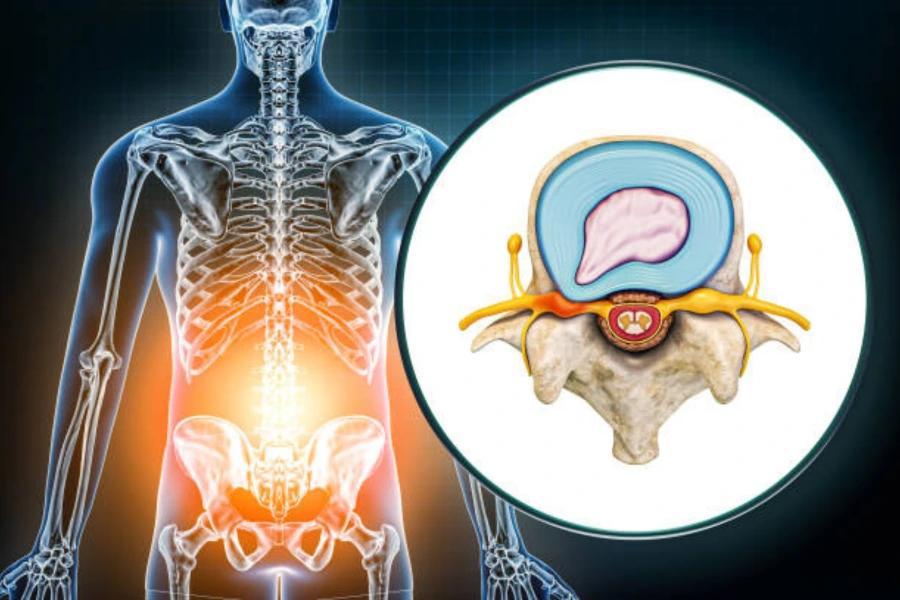
Yes, a herniated disc can often improve without surgery. In some cases, the displaced disc material actually becomes smaller over time as the body gradually breaks it down and absorbs it. Research has found that spontaneous resorption is common in lumbar disc herniations treated conservatively, although the likelihood varies depending on the type of herniation.
It helps to understand what “healing” means, though. Your symptoms can improve even if an MRI still shows a herniated disc. In other cases, follow-up imaging may show that the herniated material itself has shrunk significantly. The goal is not necessarily to make the disc look perfect again. It is to reduce pain, restore function, and make sure the affected nerves are recovering appropriately.
How quickly that happens depends on factors such as the location and type of herniation, how much a nerve is affected, the severity of your symptoms, and how you respond to nonsurgical treatment.
Below, we will explain how a herniated disc can improve naturally, how long recovery may take, what can help, and when additional treatment or surgery may need to be considered.
If ongoing back or leg pain is making everyday movement difficult, NJ Pain Therapy provides personalized pain management in New Jersey based on the source and severity of your symptoms.
Quick Answer: Can a Herniated Disc Heal Without Surgery?
Yes. Many herniated discs improve with nonsurgical treatment, and lumbar disc herniations can sometimes partially or completely resorb over time. A meta-analysis involving more than 2,200 patients found an overall resorption rate of about 70% after conservative treatment. Resorption was more common with sequestrated and extruded herniations than with contained protrusions. Much of the resorption occurred within the first six months.
That does not mean every herniated disc will disappear completely. It also does not mean pain will continue until the disc looks normal again.
Pain may improve because inflammation around the nerve decreases, pressure on the nerve changes, or the herniated material becomes smaller. Your symptoms and function may therefore improve well before a follow-up MRI would show a major structural change.
The goal of treatment is usually to help you move, function, and feel better—not simply to produce a normal-looking scan.
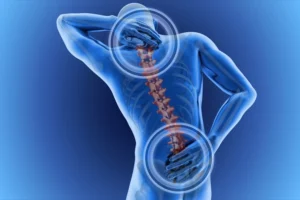
Learn more about how disc herniations can cause back, neck, and nerve-related symptoms.
How Can a Herniated Disc Heal on Its Own?
A herniated disc is not necessarily a permanent, unchanging problem. The body can respond to displaced disc material in several ways.
The Body Can Resorb Herniated Disc Material
When disc material moves outside its normal location, the body may recognize the exposed tissue and begin an inflammatory and immune response around it. Blood vessels and immune cells can contribute to breaking down and clearing some of the displaced material. The herniated tissue may also lose water and shrink.
This process is known as spontaneous resorption.
Not every type of herniation behaves the same way. Research suggests that disc material that has extruded farther from the disc—or separated from it—may actually be more likely to resorb than a smaller, contained protrusion.
That may sound surprising, but it is one reason an MRI alone cannot tell you exactly how a person’s condition will progress.
Symptoms Can Improve Before the Disc Fully Changes
Structural healing and symptom improvement do not always happen on the same schedule.
A nerve that has been irritated by a herniated disc can become less inflamed. Pressure on the nerve may decrease. The nervous system can become less sensitive as the irritation settles. Movement and strength may gradually return.
Because of this, someone can feel significantly better even if imaging would still show evidence of a disc herniation.
AAOS notes that nonsurgical treatments generally do not physically “fix” the herniated disc. Instead, they help manage symptoms while the body has time to recover and potentially absorb the herniated material.
How Long Does a Herniated Disc Take to Heal?
There is no single recovery timeline that applies to everyone.
Typical Recovery
Some people notice improvement within days or weeks. Others need several months.
According to the American Academy of Orthopaedic Surgeons, most patients with a lumbar herniated disc gradually improve over several days to weeks, and many are free of symptoms within about three to four months.
Changes visible on an MRI may take longer. Research on spontaneous resorption found that much of the structural reduction in lumbar disc herniations occurred within the first six months of conservative treatment.
Those numbers are useful as general reference points, but they are not deadlines. Someone who still has symptoms after several weeks has not necessarily “failed” to heal.
Why Recovery Time Varies
Recovery can depend on:
- The type and size of the herniation
- Where it is located
- How much a nerve is irritated or compressed
- The severity of the initial symptoms
- Whether weakness or numbness is present
- Physical demands at work or home
- Overall health
- Response to conservative treatment
Recovery is also not always a straight line. A person may feel much better for several days and then experience a temporary flare after increased activity.
What matters is the overall trend and whether pain, function, strength, and neurological symptoms are moving in the right direction.
What Symptoms May Improve as a Herniated Disc Heals?
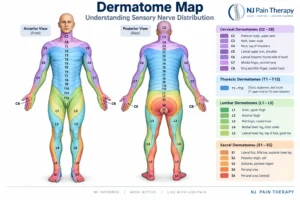
The symptoms that improve depend largely on where the herniated disc is located and which nerves are affected.
Lower Back and Leg Symptoms
A lumbar herniated disc may cause:
- Lower back pain
- Buttock pain
- Pain traveling down the leg
- Tingling or pins-and-needles sensations
- Numbness
- Weakness
- Difficulty with certain movements
When a lumbar disc irritates a nerve root that contributes to the sciatic nerve, symptoms may present as sciatica. As nerve irritation improves, leg pain, tingling, and other radiating symptoms may gradually decrease.
Neck and Arm Symptoms
A herniated disc in the cervical spine can affect nerves traveling into the shoulder, arm, hand, or fingers.
As the condition improves, a person may notice:
- Less neck pain
- Reduced shoulder or arm pain
- Less tingling or numbness
- Easier movement
- Better ability to use the arm or hand
The pattern of improvement can vary depending on which nerve is involved and how irritated it has become.
What About Weakness?
Weakness deserves more attention than pain alone.
If weakness caused by nerve irritation begins improving, that can be an encouraging sign. New weakness or weakness that is clearly getting worse should not simply be watched at home while waiting for the disc to heal.
Progressive neurological deficits are one reason a patient may need more urgent evaluation or a surgical consultation.
What Helps a Herniated Disc Heal Without Surgery?
For many patients without serious neurological deficits, conservative treatment is the first approach. Current recommendations support combining appropriate activity modification, medication, and physical therapy when clinically appropriate.
Activity Modification
You may need to temporarily reduce activities that clearly increase your pain, particularly movements involving repeated bending, lifting, or twisting.
That does not usually mean staying in bed.
Prolonged inactivity can make it harder to regain movement and strength. AAOS recommends returning to controlled activity as symptoms allow rather than remaining inactive for an extended period.
The goal is to find a reasonable middle ground: avoid repeatedly provoking severe symptoms while continuing safe movement when possible.
Physical Therapy and Appropriate Exercise
Physical therapy can help patients gradually restore movement, improve strength, and increase tolerance for everyday activity.
Exercises may focus on the muscles that support the spine, mobility, movement patterns, and a gradual return to normal activities.
Exercise should not be presented as a way to physically “push” a herniated disc back into place. Its role is more practical: helping the body move and function better while symptoms settle.
Medication
Medication may be used to manage pain or inflammation while recovery takes place. The appropriate medication depends on the patient’s symptoms, health history, other medications, and individual risks.
For patients who need an individualized approach, medication management can be incorporated into a broader pain treatment plan rather than treated as a one-size-fits-all solution.
When Pain Management May Help
A herniated disc may improve naturally, but that does not mean someone has to simply tolerate significant pain while waiting.
Pain management may be appropriate when:
- Pain remains significant
- Leg or arm symptoms interfere with normal activities
- Conservative treatment has not provided enough relief
- Nerve irritation appears to be contributing to the symptoms
- Pain makes it difficult to participate in rehabilitation or normal movement
The goal is to understand what is driving the symptoms and choose treatment accordingly.
Epidural Injections
For some patients with pain caused by an irritated spinal nerve, epidural injections may be considered.
An epidural steroid injection is intended to reduce inflammation around the affected nerve and provide symptom relief. It does not physically repair the herniated disc or force it back into position.
That distinction matters.
Reducing nerve-related pain may make it easier for a patient to move, sleep, participate in therapy, and continue through the natural recovery process while the underlying disc condition is monitored.
Creating a Treatment Plan Around the Patient
Treatment should not be chosen simply because an MRI report contains the words “herniated disc.”
A pain management physician may consider:
- Where the patient hurts
- Whether pain radiates
- Numbness or tingling
- Muscle strength
- Physical examination findings
- MRI findings
- Which nerve appears to be involved
- Treatments already attempted
- How much symptoms interfere with daily life
Two people with similar-looking MRIs can have very different symptoms. Treatment should reflect the person, not just the scan.
How Do You Know If a Herniated Disc Is Getting Better?
There is no single test you need to pass to prove that recovery is happening.
Practical signs of improvement can include:
- Pain becoming less intense
- Radiating pain traveling less far down the arm or leg
- Tingling occurring less frequently
- Improved movement
- Everyday activities becoming easier
- Better sleep
- Improving strength
- Needing fewer modifications to get through the day
Recovery may fluctuate. Doing more activity than usual can sometimes temporarily increase symptoms even when the overall trend is positive.
Pay more attention to what is happening over time than to one unusually good or bad day.
Do You Need Another MRI to Confirm the Disc Has Healed?
Not always.
If symptoms are steadily improving and neurological function is stable, proving that a herniation has disappeared on another MRI may not change treatment.
Imaging becomes more useful when symptoms persist, become significantly worse, new neurological problems develop, or the diagnosis remains unclear. MRI findings also need to be interpreted alongside the patient’s symptoms and examination rather than viewed as a diagnosis by themselves.
When a Herniated Disc May Not Heal Enough on Its Own
Natural improvement is common, but nonsurgical care does not work well enough for everyone.
Additional treatment may need to be considered when there is:
- Persistent severe pain
- Major limitations in normal activity
- Continuing arm or leg symptoms
- Little improvement despite appropriate conservative care
- Significant numbness
- Progressive muscle weakness
The decision depends on what is happening clinically rather than how many weeks have passed on the calendar.
When Surgery May Be Considered
Only a minority of patients with lumbar disc herniations require surgery. Surgery is generally considered when appropriate nonsurgical treatment has not sufficiently relieved symptoms or when significant neurological problems are present.
Reasons for a surgical evaluation can include persistent disabling radiating pain, progressive weakness or numbness, significant difficulty standing or walking, or loss of normal bowel or bladder function.
Symptoms That Need Prompt Medical Attention
Do not simply wait for a herniated disc to improve if you develop:
- New loss of bowel or bladder control
- Numbness around the genital or rectal area
- Significant or rapidly worsening weakness
- Serious difficulty standing or walking
These symptoms can indicate significant nerve compression and warrant prompt medical evaluation.
Frequently Asked Questions
Can a Herniated Disc Completely Go Away?
It can in some cases. Studies using follow-up imaging have shown that herniated disc material can shrink substantially or even completely resorb during conservative treatment. This is more likely with some types of herniation than others, so complete disappearance should not be expected in every patient.
Can a Herniated Disc Heal Without Physical Therapy?
Some herniated discs improve naturally without formal physical therapy. However, physical therapy may be recommended to help restore movement, improve strength, and safely increase activity based on the patient’s symptoms.
Does a Herniated Disc Go Back Into Place?
Not necessarily. Improvement usually should not be pictured as the disc simply “popping” back into its original position. Herniated material may lose volume or be resorbed, while inflammation and nerve irritation can also decrease.
Can You Make a Herniated Disc Worse?
Certain movements or activities can aggravate symptoms, especially during an acute flare. That does not mean all movement should be avoided. Activity is generally modified based on symptoms, with a gradual return to controlled movement as tolerated.
How Do I Know If My Herniated Disc Needs Treatment?
Consider an evaluation when pain remains significant, radiates into an arm or leg, causes persistent numbness or tingling, interferes with normal activities, or is accompanied by weakness. Progressive neurological symptoms require more prompt attention.
Finding Treatment for a Herniated Disc
Many herniated discs can improve without surgery. The displaced material may become smaller over time, inflammation can settle, and irritated nerves can gradually recover. But natural recovery does not happen on exactly the same schedule for every patient.
Some people improve quickly. Others continue to experience back pain, neck pain, sciatica, numbness, or other nerve-related symptoms that make everyday life difficult.
The right approach should be based on what the herniated disc is actually doing—not simply the fact that it appears on an MRI.
For patients with persistent back, neck, or radiating nerve symptoms, NJ Pain Therapy offers individualized pain treatment in New Jersey designed around the diagnosis, symptoms, and goals of each patient.