Bulging discs and herniated discs are easy to confuse. The terms are often used when discussing back or neck pain, and both describe changes to the discs that sit between the bones of your spine. But they are not the same thing.
A bulging disc generally involves a broader portion of the disc extending beyond its normal boundary, while a herniated disc involves a more localized displacement of disc material. Importantly, either finding can show up on imaging without causing pain. When symptoms do occur, they often depend on where the affected disc is located and whether it is irritating or compressing a nearby nerve.
Below, we will break down the difference between bulging and herniated discs, the symptoms they can cause, why they happen, how doctors diagnose disc-related pain, and the treatments that may help.
If persistent back or neck pain is affecting your day-to-day life, NJ Pain Therapy provides personalized pain management in New Jersey based on your symptoms and individual needs.
Quick Answer: Bulging Disc vs Herniated Disc
A bulging disc occurs when a broader portion of the disc extends beyond its normal boundary. A herniated disc involves a more localized displacement of disc material. These terms describe what the disc looks like structurally; they do not tell you by themselves how painful or serious the condition is.
Both can potentially irritate nearby nerves, but both can also exist without causing symptoms. What matters most is how the imaging findings line up with your pain, neurological symptoms, and physical examination. Degenerative disc findings are common even in people who do not have back pain.
| Bulging Disc | Herniated Disc |
| Broader disc extension | More localized displacement |
| May cause no symptoms | May cause no symptoms |
| Can irritate nearby nerves | Can irritate nearby nerves |
| Treatment depends on symptoms | Treatment depends on symptoms |
Understanding What Happens to a Spinal Disc
How Spinal Discs Work
Your spine is made up of bones called vertebrae stacked on top of one another. Between most of these vertebrae are intervertebral discs that help cushion the spine and allow it to move.
Each disc has a tougher outer portion surrounding a softer, gel-like center. Over time, or because of stress placed on the spine, the shape and condition of a disc can change.
These discs deal with pressure every day as you sit, stand, bend, twist, lift, and move. That does not mean normal activity is harmful, but it helps explain why age-related and mechanical changes to spinal discs are so common.
What Happens When a Disc Changes
A disc does not have to look perfect on an MRI for your spine to function normally. In fact, disc bulges and other degenerative changes are frequently found in people who have no symptoms at all, particularly as they get older.
Problems can develop when a disc change affects a nearby nerve or contributes to inflammation around a nerve root. Depending on the location, that can cause pain in the spine itself or symptoms that travel into an arm or leg.
Learn more about how disc herniations can affect nearby nerves and contribute to back, neck, or radiating pain.
What is the Difference Between a Bulging and Herniated Disc?
The main difference is the shape and extent of the disc material that extends beyond its normal boundary.
Bulging Disc
A bulging disc involves a broader change in the contour of the disc. Instead of one small area pushing outward, a larger portion of the disc extends beyond where it would normally sit.
Disc bulging is often associated with degenerative changes in the spine and becomes increasingly common with age. That does not necessarily make it painful. Research looking at people without back pain has found disc bulges and other degenerative findings on imaging at many ages, with their prevalence increasing as people get older.
A bulging disc becomes more clinically important when its location corresponds with a person’s symptoms or when it affects nearby nerve structures.
Herniated Disc
A herniated disc involves a more localized displacement of disc material beyond the normal disc space. Herniations can develop as a disc degenerates over time or can occur in connection with strain or injury.
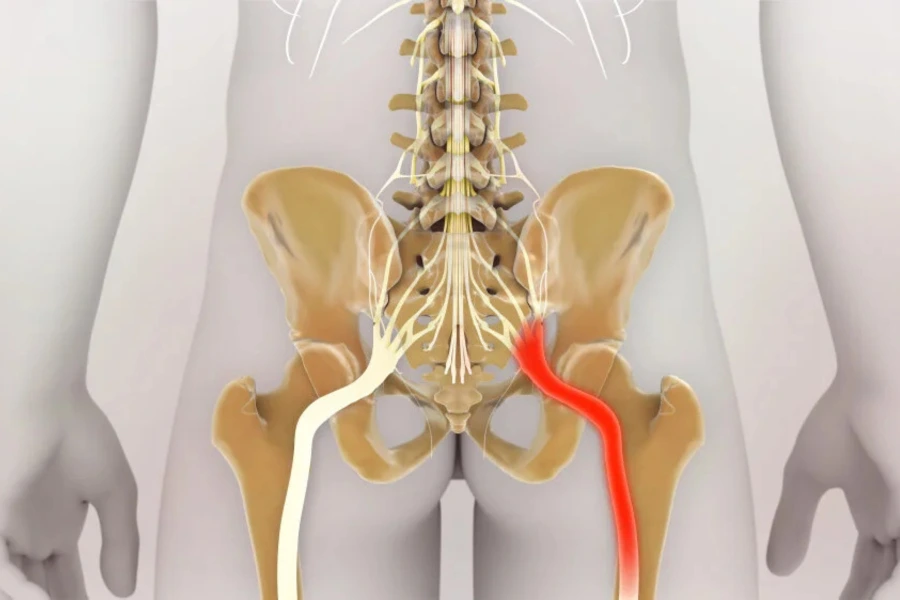
When a herniated disc affects a nerve root, it can produce symptoms away from the spine. A herniated disc in the lower back, for example, may cause pain, tingling, numbness, or weakness that travels into the buttock or leg.
Is a Herniated Disc Worse Than a Bulging Disc?
Not necessarily.
It is tempting to think of a bulging disc as a mild problem and a herniated disc as a severe one, but the terminology alone does not tell you how much pain someone will experience.
A relatively small disc problem in a location that affects a nerve may produce noticeable symptoms, while a more obvious finding on an MRI may cause no symptoms at all. This is why doctors look beyond words such as “bulge” or “herniation” and consider where the abnormality is located, whether nerves are involved, and whether the imaging findings match what the patient is experiencing.
Symptoms of Bulging and Herniated Discs
Symptoms can vary significantly depending on where the affected disc is located and whether a nerve is being irritated or compressed.
Lower Back Symptoms
When a disc problem occurs in the lumbar spine, symptoms may include:
- Localized lower back pain
- Buttock pain
- Pain traveling down the leg
- Tingling or pins-and-needles sensations
- Numbness
- Weakness in the leg or foot
If a lumbar disc irritates a nerve that contributes to the sciatic nerve, it may produce sciatica, which commonly causes radiating pain from the lower back or buttock into the leg.
NJ Pain Therapy evaluates different potential causes of persistent back pain, including disc-related conditions. You can also learn more about symptoms and treatment options for sciatica.
Neck Symptoms
A disc problem in the cervical spine may cause symptoms around the neck, shoulder, arm, or hand. These can include:
- Neck pain
- Shoulder or shoulder blade pain
- Pain traveling down an arm
- Tingling or numbness in the arm, hand, or fingers
- Muscle weakness
Where the symptoms travel can give a physician useful information about which nerve may be involved.
Persistent neck pain should be evaluated based on the complete pattern of symptoms rather than assuming a disc finding on an MRI is automatically the cause.
Can You Have a Bulging or Herniated Disc Without Pain?
Yes.
This is one of the most important things to understand about spinal imaging. Disc bulges, protrusions, and other degenerative changes can be found in people who feel completely fine. A systematic review of imaging in asymptomatic people found that many degenerative spine findings become increasingly common with age.
An MRI finding therefore needs context. If the location of a disc abnormality matches the patient’s pain pattern, neurological symptoms, and examination findings, it may be relevant. If it does not, the physician may need to look for another source of the pain.
What Causes Bulging and Herniated Discs?
Spinal discs naturally change with age. As a disc degenerates, it can lose some of its flexibility and ability to handle stress. Repeated forces on the spine may also contribute to disc problems over time.
Factors that may contribute include:
- Normal age-related disc degeneration
- Repetitive bending or lifting
- Frequent twisting
- Physically demanding work or activities
- Sudden strain or injury
- Long periods of stress placed on the spine
- Individual health and lifestyle factors
There is not always a dramatic moment when a disc becomes damaged. Some people can point to a specific lift, fall, or movement that triggered their symptoms. For others, discomfort develops gradually as the disc changes over time.
How Doctors Diagnose Disc-Related Pain
Finding a bulging or herniated disc is only one part of figuring out what is causing someone’s pain.
Medical History and Examination
A doctor will usually begin by asking questions about the symptoms, including:
- Where the pain starts
- Whether it travels into an arm or leg
- Whether there is numbness or tingling
- Whether weakness is present
- Which movements or positions make symptoms worse
A physical and neurological examination may also assess movement, strength, sensation, reflexes, and other findings that can help identify whether a particular nerve is involved.
Imaging
MRI is commonly used when detailed imaging of spinal discs, nerve roots, and other soft tissues is needed. It can show where a disc has changed and whether nearby structures appear to be affected.
But an MRI should not be read in isolation. Seeing the words “disc bulge” or “disc herniation” on a report does not automatically mean that finding is responsible for the patient’s pain.
Matching the MRI to the Symptoms
This is where the full clinical picture matters.
Doctors compare the location of the disc abnormality with the patient’s symptoms and examination findings. For example, pain or numbness following the path of a particular nerve may make an imaging finding at the corresponding spinal level more meaningful.
The goal is not simply to find something abnormal on a scan. It is to determine whether that abnormality actually helps explain what the patient is feeling.
Treatment for Bulging and Herniated Discs
Treatment depends on the symptoms, how long they have been present, whether nerves are involved, and how much the condition is affecting daily life.
Conservative Treatment
Many disc-related problems are initially treated without surgery. Depending on the individual, conservative care may include:
- Temporarily modifying painful activities
- Physical therapy
- Appropriate exercises and movement
- Medication when medically appropriate
- Gradually returning to normal activity as symptoms improve
Most people with a lumbar herniated disc do not require surgery, and symptoms often improve with nonsurgical care.
Pain Management Options
When symptoms continue despite conservative care, a pain management physician can evaluate whether a more targeted treatment makes sense.
For certain cases involving an irritated spinal nerve, epidural injections may be considered to help reduce inflammation and provide symptom relief. Epidural steroid injections are one of the nonsurgical treatments used for some patients with symptomatic disc herniation and radicular pain.
Medication management may also play a role for certain patients. Other interventional approaches can be considered depending on the actual source of pain rather than simply the wording of an MRI report.
Does a Herniated Disc Always Require Surgery?
No. Most herniated discs are initially managed nonsurgically, and many patients improve over time.
Surgery may be considered when significant symptoms continue despite appropriate nonsurgical treatment or when serious neurological problems develop. Significant or worsening weakness, loss of bowel or bladder control, or loss of sensation around the genital or rectal area requires prompt medical evaluation because these symptoms can indicate serious nerve compression.
Frequently Asked Questions
Is a bulging disc the same as a herniated disc?
No. A bulging disc generally describes a broader extension of the disc beyond its normal boundary, while a herniated disc describes a more localized displacement of disc material. They are different structural descriptions rather than interchangeable terms.
Which Is Worse, a Bulging Disc or a Herniated Disc?
Neither is automatically worse. The severity of symptoms depends more on factors such as location, nerve involvement, and the patient’s individual condition than on whether an imaging report uses the word “bulging” or “herniated.”
Can a Bulging Disc Turn Into a Herniated Disc?
Disc structure can continue to change as degeneration or injury progresses, but a bulging disc should not simply be viewed as an inevitable early stage of a herniated disc. The two terms describe different patterns of disc morphology.
Can a Herniated Disc Heal Without Surgery?
Many people with symptomatic herniated discs improve without surgery. Initial treatment is commonly nonsurgical, and the body can gradually reduce or resorb some herniated disc material over time.
Can a Bulging or Herniated Disc Cause Sciatica?
Yes. A disc abnormality in the lower spine can contribute to sciatica when it affects a nerve root involved in the sciatic nerve. This may cause pain, tingling, numbness, or weakness that travels from the lower back or buttock into the leg.
Finding Treatment for Disc-Related Pain
Bulging discs and herniated discs describe different structural changes, but neither diagnosis tells the whole story. Some people have significant disc findings without pain, while others develop noticeable symptoms when a disc affects a nearby nerve.
That is why effective treatment starts with understanding how the symptoms, physical examination, nerve involvement, and imaging findings fit together. Persistent back pain, neck pain, or symptoms that travel into an arm or leg deserve an evaluation focused on identifying the actual source of the problem.
For patients dealing with persistent spine or nerve-related symptoms, NJ Pain Therapy offers individualized pain treatment in New Jersey focused on identifying the source of pain and finding an appropriate path forward.
SEO Title: Bulging Disc vs Herniated Disc: Key Differences
URL Slug:
/blog/bulging-disc-vs-herniated-disc/
Meta Description:
Learn the difference between a bulging disc vs herniated disc, including symptoms, causes, diagnosis, and treatment options.