
Nerve pain symptoms should not be ignored when they are persistent, getting worse, spreading, or connected to numbness, tingling, weakness, or loss of function.
Nerve pain can feel very different from muscle or joint pain. It may feel burning, electric, tingling, sharp, shooting, or numb. Some people describe it as pins and needles. Others feel pain that travels from the neck into the arm or from the lower back into the leg.
At first, nerve symptoms may come and go. You may feel them only during certain movements, after sitting too long, while walking, or at night. But if symptoms keep returning or getting stronger, it is worth paying attention.
Ignoring worsening nerve symptoms can allow the underlying issue to progress. Early evaluation can help identify the source before symptoms become harder to manage.
If nerve pain symptoms are affecting your daily life, The Center for Regenerative Therapy and Pain Management offers pain management treatments in New Jersey to help evaluate your symptoms and explore your options.
What Nerve Pain Can Feel Like
Burning pain
Burning pain can be a sign of nerve irritation or sensitivity.
This type of pain may feel hot, raw, or like a sunburn under the skin. It can happen in the back, neck, arms, hands, legs, or feet. Some people feel burning in one specific area, while others feel it travel along a pathway.
Burning pain that keeps happening, spreads, or comes with numbness, tingling, or weakness should be evaluated. It may point to an irritated nerve, nerve compression, inflammation, or another condition affecting the nervous system.
Tingling or pins and needles
Tingling may feel like buzzing, prickling, pins and needles, or a limb “falling asleep.”
Sometimes tingling happens for a simple reason, like sitting in one position too long. If pressure is removed and the tingling goes away quickly, it may not be serious.
But repeated, unexplained, or worsening tingling should not be ignored. It may happen when a nerve is compressed, irritated, inflamed, or not functioning normally.
Tingling that travels into the arm, hand, leg, or foot is especially worth discussing with a provider.
Numbness
Numbness means reduced sensation.
It may feel like an area is asleep, dull, heavy, or harder to feel. You may notice that your hand does not grip normally, your foot feels less stable, or one area of skin feels different from the other side.
Persistent numbness should be evaluated because it may affect grip, balance, walking, coordination, or safety. Numbness can also be a sign that a nerve is not sending signals properly.
Even if numbness is not painful, it still matters.
Shooting or electric pain
Nerve pain can feel sharp, sudden, electric, or zapping.
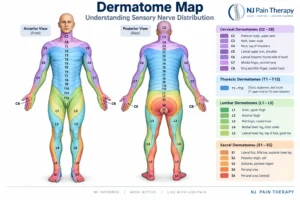
It may shoot along a pathway instead of staying in one spot. For example, pain may travel from the neck into the shoulder, arm, hand, or fingers. It may also travel from the lower back into the buttock, thigh, calf, or foot.
Radiating pain may point to irritated spinal nerves. If shooting or electric pain keeps happening, worsens, or travels farther down the arm or leg, it should be evaluated.
Nerve Pain Symptoms That Need Attention
Pain that travels down the arm or leg
Pain that starts in the neck or back and travels outward may involve a nerve.
Arm symptoms may be related to irritated nerves in the neck. Leg symptoms may be related to irritated nerves in the lower back. This type of pain may feel sharp, burning, electric, tingling, or shooting.
Pain traveling below the knee or into the foot should be evaluated. The same is true for pain traveling into the hand or fingers.
Radiating pain does not always mean something severe is happening, but it is a sign that the source may be more than simple muscle soreness.
Weakness
Weakness is more concerning than pain alone.
It may show up as trouble gripping objects, lifting your foot, climbing stairs, standing from a chair, raising your arm, or walking normally. Some people notice they are tripping more often or dragging one foot.
Weakness may suggest that a nerve is not functioning properly. New or worsening weakness should be evaluated quickly, especially if it appears suddenly or continues to progress.
Pain can be uncomfortable. Weakness can affect function. That is why it should be taken seriously.
Loss of coordination or balance
Nerve problems can affect stability and movement control.
You may feel unsteady, trip more often, stumble, drop objects, or feel like your hand or foot is not responding the way it should. Balance changes can happen when nerve signals are disrupted or when weakness affects how you move.
These symptoms should not be brushed off, especially if they are getting worse.
Loss of coordination or balance may need prompt evaluation to understand whether the issue is coming from the spine, peripheral nerves, or another medical condition.
Symptoms on both sides of the body
Nerve symptoms on both sides of the body may suggest a broader issue.
This can include both legs, both feet, both hands, or symptoms that affect both sides at the same time. Bilateral symptoms may be related to spine conditions, peripheral nerve problems, inflammation, or another medical issue.
Symptoms on both sides do not automatically mean an emergency, but they should be discussed with a provider.
This is especially important if both-sided symptoms are new, worsening, spreading, or paired with weakness, numbness, balance problems, or changes in bladder or bowel control.
When Nerve Pain May Be Coming From the Spine
Neck-related nerve symptoms
Irritated nerves in the neck can cause symptoms beyond the neck itself.
Pain may spread into the shoulder, arm, hand, or fingers. It may feel sharp, burning, tingling, electric, or shooting. Some people also notice numbness, weakness, or changes in grip strength.
Neck movement may make symptoms worse. Looking up, turning the head, or holding the neck in one position for too long may trigger pain or tingling.
Weakness or numbness in the arm or hand should be evaluated, especially if it is new or worsening.
Lower back-related nerve symptoms
Irritated nerves in the lower back can cause symptoms in the buttock, hip, thigh, calf, or foot.
These symptoms may include shooting pain, burning, tingling, numbness, leg heaviness, or weakness. Some people feel symptoms only on one side. Others may feel symptoms that change with position or activity.
Standing, walking, sitting, bending, or coughing may make symptoms better or worse depending on the cause.
Evaluation matters when symptoms spread, travel below the knee, affect walking, or interfere with daily life.
Spinal stenosis and nerve compression
Spinal stenosis happens when there is narrowing around the spinal nerves.
This narrowing can create pain, numbness, heaviness, tingling, or weakness. Symptoms may worsen with standing or walking because those positions can place more pressure around the nerves.
Some people feel better when they sit down or bend forward. Others notice they need to lean on a shopping cart, counter, or railing to walk more comfortably.
Progressive symptoms should be evaluated, especially if walking tolerance is getting worse or leg symptoms are becoming more noticeable.
Nerve Pain vs. Muscle Pain: Why the Difference Matters
Muscle pain patterns
Muscle pain often feels sore, tight, achy, or tender.
It usually stays closer to the injured, strained, or overworked area. Muscle pain may improve with rest, stretching, heat, massage, or gentle movement.
Muscle pain can still be very uncomfortable. But it usually does not cause numbness, electrical sensations, radiating pain, or true weakness.
If pain stays local and improves as the muscle recovers, it may be less concerning. If symptoms travel, tingle, burn, or affect strength, nerves may be involved.
Nerve pain patterns
Nerve pain often feels different.
It may burn, tingle, shoot, radiate, or feel electric. It may travel along a pathway, such as from the neck into the arm or from the lower back into the leg.
Nerve pain may also come with numbness, weakness, altered sensation, heaviness, or coordination changes. These symptoms need a different evaluation than simple muscle soreness.
The location of the pain may not be the true source. For example, leg symptoms may start from a nerve problem in the lower back. Arm symptoms may start from a nerve problem in the neck.
Why guessing can delay care
Many people assume nerve symptoms are just tight muscles.
That can delay the right diagnosis. Stretching aggressively may also irritate some nerve symptoms, especially if the nerve is already sensitive or compressed.
Waiting too long may allow symptoms to worsen, spread, or affect function. A proper diagnosis helps guide the right treatment and can help prevent unnecessary trial and error.
The goal is not to panic over every tingle. The goal is to know when nerve symptoms deserve attention.
Red Flags: When to Seek Urgent Care
Severe or sudden weakness
Sudden weakness in the arm, hand, leg, or foot should be taken seriously.
This may show up as trouble walking, lifting the front of the foot, climbing stairs, gripping objects, raising the arm, or using the hand normally. Some people notice they are dropping things, dragging a foot, or feeling like one limb is not responding the way it should.
Weakness can mean a nerve is not working properly. If weakness appears suddenly, gets worse quickly, or affects your ability to move safely, you should seek urgent medical evaluation.
Loss of bladder or bowel control
Loss of bladder or bowel control with back pain or nerve symptoms can be a medical emergency.
This is not something to wait on or monitor at home. If you develop new trouble controlling urination or bowel movements, especially with back pain, leg symptoms, numbness, or weakness, seek emergency care immediately.
Fast evaluation matters because some nerve-related conditions need urgent treatment.
Numbness in the groin or saddle area
Numbness around the groin, inner thighs, buttocks, or saddle area is a serious warning sign.
This can feel like reduced sensation where your body would touch a saddle if you were sitting on one. It may happen with severe back pain, leg symptoms, bladder changes, or bowel changes.
This symptom should be evaluated urgently. Do not ignore it or assume it will go away on its own.
Rapidly worsening symptoms
Nerve symptoms that are spreading, intensifying, or progressing quickly need prompt medical attention.
This is especially important when pain is paired with weakness, numbness, fever, trauma, balance problems, or trouble walking. A mild symptom that slowly improves may be less concerning, but symptoms that are clearly getting worse should not be brushed off.
When nerve symptoms change fast, it is better to get checked than to guess.
Common Causes of Nerve Pain Symptoms
Herniated or bulging discs
Herniated or bulging discs can irritate nearby nerves.
Spinal discs sit between the bones of the spine. When a disc bulges or herniates, it may place pressure on a nerve or trigger inflammation around it.
Symptoms depend on where the irritated nerve is located. A disc problem in the neck may cause pain, tingling, numbness, or weakness into the shoulder, arm, hand, or fingers. A disc problem in the lower back may cause symptoms into the buttock, leg, calf, or foot.
Pain may worsen with certain positions or movements, such as sitting, bending, lifting, coughing, or twisting.
Spinal stenosis
Spinal stenosis happens when there is narrowing around the nerves in the spine.
This narrowing can cause pain, heaviness, numbness, tingling, or weakness. It often affects walking or standing tolerance, especially when the lower back is involved.
Some people feel better when they sit down or lean forward. Others notice they can walk farther when leaning on a shopping cart, counter, or railing.
Spinal stenosis symptoms can develop gradually, but they should be evaluated if they are limiting movement or getting worse.
Peripheral neuropathy
Peripheral neuropathy involves irritation or damage to nerves outside the brain and spinal cord.
It can affect the feet, legs, hands, or arms. Symptoms may include burning, tingling, numbness, sensitivity, stabbing pain, or a reduced ability to feel temperature or pressure.
Some people notice symptoms more at night. Others feel numbness, balance changes, or burning in the feet.
Peripheral neuropathy should be evaluated to understand the cause and determine the right next step.
Inflammation or injury
Inflammation, trauma, repetitive stress, or compression can also irritate nerves.
This may happen after an injury, overuse, swelling, poor positioning, or ongoing pressure on a nerve. Symptoms may start small, then become more noticeable over time.
You may first notice mild tingling or burning. Later, symptoms may become more frequent, spread farther, or start affecting strength or movement.
Persistent nerve symptoms should not be ignored, especially when they continue despite rest or basic home care.
How a Pain Management Specialist Can Evaluate Nerve Pain
Symptom pattern review
A pain management specialist will usually start by reviewing your symptom pattern.
This includes where symptoms start, where they travel, what makes them better or worse, and whether they are constant or come and go. Your provider may ask whether symptoms change with sitting, standing, walking, bending, neck movement, sleep position, or activity.
They will also want to know if you have numbness, tingling, weakness, burning, balance changes, or pain that travels into the arm or leg.
These details help narrow down whether the source may involve the spine, discs, joints, nerves, inflammation, or another condition.
Physical exam
A physical exam helps connect your symptoms to how your body is functioning.
This may include strength testing, reflex testing, sensation testing, and movement testing. Your provider may check how your neck, back, arms, legs, joints, and nerves respond to certain positions.
The goal is to see whether there are signs of nerve irritation, nerve compression, weakness, reduced sensation, or movement patterns that may be contributing to symptoms.
A physical exam can provide important clues, especially when pain does not stay in one place.
Imaging or testing when needed
Imaging may be recommended depending on your symptoms.
An MRI or other imaging test may help identify disc issues, spinal stenosis, nerve compression, inflammation, or other structural causes. In some cases, additional testing may be needed to better understand nerve function.
Not every case needs imaging immediately. If symptoms are mild and improving, conservative care may be considered first. But if symptoms are persistent, worsening, spreading, or connected to weakness or numbness, testing may help guide the next step.
Treatment Options for Nerve Pain Symptoms
Treatment depends on the source
Nerve pain is a symptom, not a final diagnosis.
The right treatment depends on what is irritating the nerve. The source may involve the spine, discs, joints, inflammation, narrowing around nerves, or peripheral nerve issues.
That is why guessing usually does not work well. Burning, tingling, numbness, or radiating pain can point toward nerve involvement, but the exact cause still needs to be identified.
Once the source is clearer, treatment can be more targeted.
Possible treatment options
Depending on the diagnosis, treatment options may include Medication Management, Nerve Blocks, Steroid Injections, Epidural Injections, Radiofrequency Ablation, or Spinal Cord Stimulators.
These treatments are not used for every case of nerve pain. The right option depends on the diagnosis, symptom severity, how long symptoms have been present, and how much they are affecting daily life.
For example, some patients may need medication management to help control nerve-related symptoms. Others may benefit from injections that target inflammation or irritated nerves. For certain chronic nerve pain conditions, advanced options may be considered when more conservative treatments are not enough.
The Center for Regenerative Therapy and Pain Management sees patients in Shrewsbury and Toms River, helping people identify the source of nerve pain symptoms and explore treatment options based on their condition.
Frequently Asked Questions About Nerve Pain Symptoms
What are common nerve pain symptoms?
Common nerve pain symptoms include burning, tingling, numbness, shooting pain, electric pain, sensitivity, weakness, or pain that travels into the arm or leg.
Some people also describe nerve pain as buzzing, stabbing, zapping, or pins and needles.
When should I worry about nerve pain?
You should worry about nerve pain if it is worsening, spreading, lasting more than a few weeks, causing numbness or weakness, affecting walking or grip strength, or interfering with daily life.
You should seek urgent care if nerve symptoms are sudden, severe, or paired with loss of bladder or bowel control, saddle-area numbness, or sudden weakness.
Can nerve pain go away on its own?
Some mild nerve irritation may improve on its own, especially if the pressure or irritation resolves.
However, persistent, worsening, or spreading nerve symptoms should be evaluated. It is important to identify the cause before symptoms become harder to manage.
Is burning pain usually nerve pain?
Burning pain can be a sign of nerve irritation, but it is not the only possible cause.
Inflammation, skin conditions, circulation issues, and other medical problems may also cause burning sensations. A medical evaluation can help determine where the pain is coming from.
What does nerve pain in the leg feel like?
Nerve pain in the leg may feel sharp, burning, tingling, electric, shooting, or radiating.
It may travel from the lower back into the buttock, thigh, calf, or foot. Some people also feel numbness, leg heaviness, weakness, or pins and needles.
What nerve symptoms are an emergency?
Severe weakness, loss of bladder or bowel control, numbness in the groin or saddle area, or rapidly worsening neurological symptoms should be treated as urgent or emergency symptoms.
These symptoms may suggest serious nerve involvement and should be evaluated right away.
Conclusion
Nerve pain can feel burning, tingling, numb, sharp, shooting, or electric.
Symptoms that spread, worsen, or affect strength should not be ignored. Nerve pain may come from the spine, discs, spinal stenosis, inflammation, injury, or peripheral nerves.
The source matters because treatment depends on the cause. Early evaluation can help identify what is irritating the nerve and guide the right next step.
If you are dealing with nerve pain symptoms that are getting worse, spreading, or affecting your daily life, The Center for Regenerative Therapy and Pain Management offers pain management treatments in New Jersey to help identify the source and build a treatment plan that fits your symptoms.